

If that workload does expand in usage, and the economics of orbital DCs make sense (with high launch costs, zero ability to do maintenance, and weight penalties for shielding and radiators), then surely ocean based data centers (e.g. Panthalassa) make more sense (lower 'launch' costs, high but existant latency on maintenance, no weight penalties), and if those make sense then surely the distributed land based facilities (e.g. Rune Energy) or home based facilities (e.g. Span XFRA) make even more sense (easier maintenance, low/no permitting overhead because they're covered by existing permits, reasonable quality terrestrial fiber internet).
Will we put data centers in space? (forethought.org)
54 pointsby simonebrunozzi7 hours ago161 comments
asciimike 6 hours ago
The viability of space DCs seem to depend entirely on the existence of higher latency, lower throughput, single card to single server workloads, which IMO isn't the primary class of workload today (and if one holds the belief that frontier models will maintain their dominant position, this will remain rack/row/facility level, which isn't viable for orbital facilities to handle as currently designed).
dboreham 4 hours ago
I don't think we need that many words. It's an obviously preposterously stupid idea that has been promoted only to defraud investors.
rightnutwingjob 3 hours ago
Correct.
And putting things in the ocean is only marginally less idiotic due primarily to sea water being corrosive, wet, and full of creatures that tend to want to grow all over anything.
NortySpock 3 hours ago
Microsoft did attempt ocean racks in a sealed container , and it sounded like the 3 year test ended successfully but was not renewed.
I presume the cost of setup, teardown, lead-time, low power density when scaled up, and lack of convenient access for mid-life repairs made it not worth the trouble
cogman10 3 hours ago
This is the sort of thing that highlights why space is such a dumb place to put a DC.
Everything about storing a DC underwater is easier than it is in space (except corrosion).
It's easier to access, cheaper, easier to cool, easier to get enough power, easier to update.
Heck, doing a second story data-center resolves a ton of issues with today's data-centers (while being a bit more expensive due to additional structural support requirements).
There are so many options for terrestrial DCs to overcome whatever problem space might supposedly solve, and they are all cheaper than the space solution.
dgoldstein0 3 hours ago
how is power easier? solar power in orbit seems like a no-brainer - no losses due to the atmosphere / weather, and with the right orbit you can get sun all the time. Was the ocean DC tide-powered or something? how does that compare?
munchbunny 2 hours ago
In Microsoft’s case, they ran a cable, which is much simpler to do than putting solar panels in orbit.
cogman10 2 hours ago
In space, you have to deploy all the power production you want to consume in the same package that's consuming that power.
On earth, you can build a power plant miles from the DC. And you can use all sorts of different sources of power, tidal, wind, nuclear, solar, fossil fuels. All options. And like the DC, if there's a problem with any of those sources, you can go fix it or replace it with different power sources. If there's a problem with the solar panels in space, your DC is dead.
That's both easier and a lot more flexible.
bayindirh an hour ago
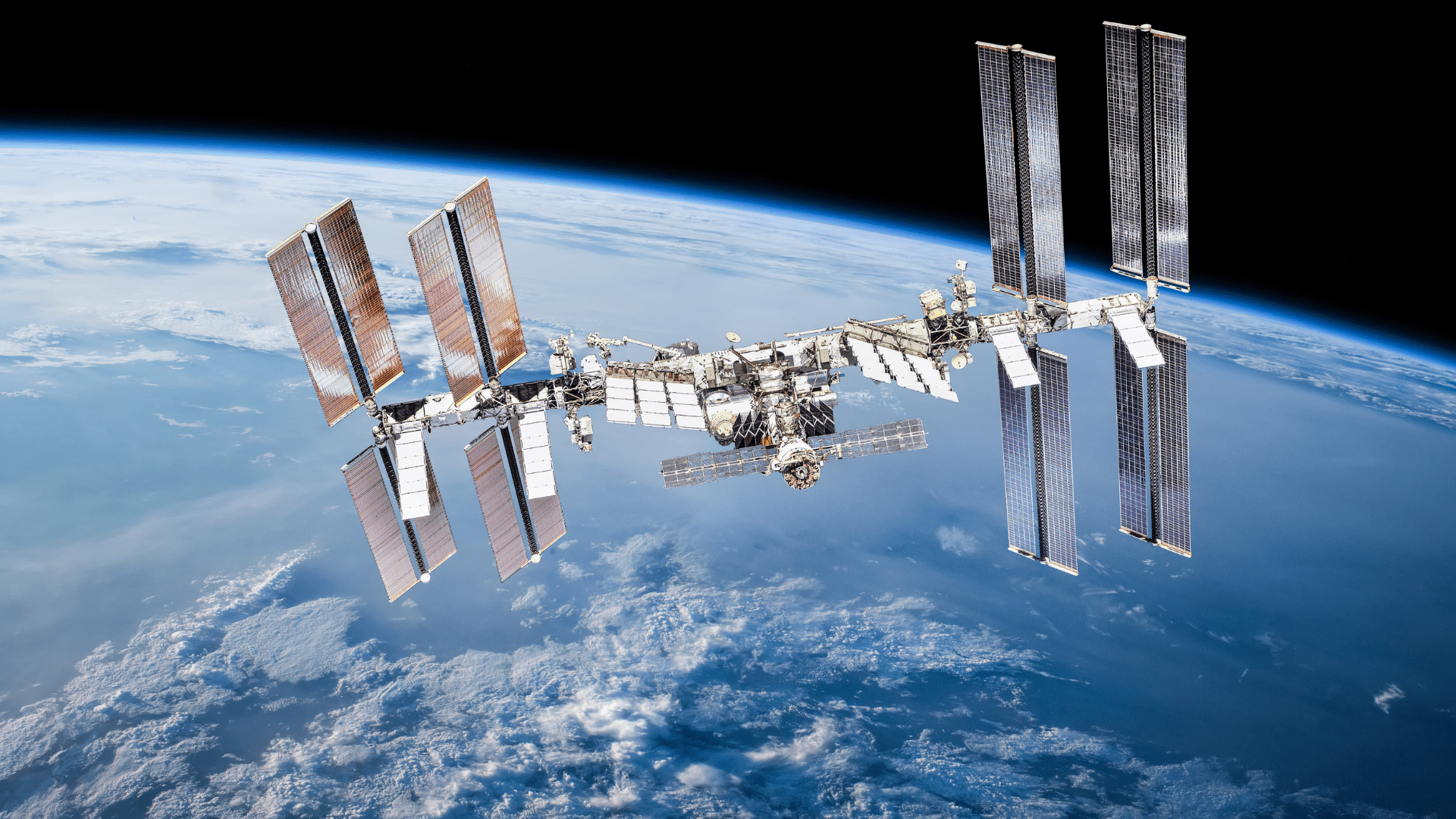
It looks like ISS can generate 240KW peak from 2500m2 of solar panels, and runs at half of that nominally [0].
A single B200 can consume up to 1200W. A single GB300 system needs 14.5kW. So, you can only have ~15 (incl. satellite's energy needs) GB300 with ISS' solar panels, which is absurd. See [1] for the size of the panels we're talking about.
People dream about Starlink-style close flying systems to aggregate them to a single data center. With these power requirements, it's more like an AI hallucination. If we can build way more efficient chips or run smaller models on modest hardware, etc. We may go there, but needing ISS sized solar panels to run frontier models in space?
Also, don't forget the radiators. You also need those to pump that heat out of these systems.
The outlook doesn't look good at this point.
[0]: https://en.wikipedia.org/wiki/Solar_panels_on_spacecraft#Spa...
[1]: https://www.sgmk.edu.pl/wp-content/uploads/2025/10/iss.png
chmod775 2 hours ago
> except corrosion
Spacecraft in LEO deal with corrosion from - among other causes - atomic oxygen atoms up there, which are eager to cause oxidation in almost anything they come in contact with. The rate of this can be greater than on Earth's surface, though I'm not sure how oceans compare for corrosion.
Overall it's probably true that it's less of an issue than with sea water, but it's not a nonissue either.
horsawlarway 2 hours ago
Yes, but that apparently proves the point of the poster above you.
The moderate improvements in cooling we're not worth the extra complexity.
So it just didn't make sense to do outside of a single media stunt project.
Data centers in space don't even get the cooling benefit.
The whole idea just doesn't survive modest consideration. Data centers aren't particularly dangerous. There's no forcing function to put them away from where people live. The best location for a data center is going to be a decent sized urban center with existing utilities (power and network) and acceptable land costs.
There are nearly forty of them in Atlanta, people walk by them every day with no idea what they are.
cactusplant7374 an hour ago
How is Panthalassa doing? Anyone know?
bliteben 3 hours ago
I think if we manufactured most of the infrastructure and maybe the chips or solar panels in space it might actually make sense. Nobody is talking about that though, I guess Elon is saving the we will make the solar panels in space for a down quarter.
skort 3 hours ago
How would it make sense? Have you seen how things are manufactured? Why would you want to make something harder and more expensive than it has to be? It's delusional to think that these things will work better in space/on mars than on earth.
rbanffy 2 hours ago
Some metallurgy on the Moon might be easier - at least the atmosphere doesn’t want to react with the materials. For other processes, you actually want some of the atmosphere to do exactly that.
We’ll need to develop base industries from scratch for these environments, but, eventually, we’ll get there. The downside is that it’ll take at least multiple decades, if not more than a century.
rbanffy 2 hours ago
I would not expect that to happen any sooner than 50 years from now. If a flight to the Moon on a Starship really requires a dozen refuelling flights, then we need an even bigger rocket (because the larger a rocket is, the more efficient it gets). Then we need to develop and build automated and teleoperated lunar factories, maybe ship the electronics from Earth for final assembly on the Moon, establish lunar mining and metalworking to build the structures, motors, actuators, solar panels, radiators, find raw materials and process them into heat exchanger fluids and propellants, and launch the satellites at least to Lunar orbit so they can self propel to their destination orbit where latency is not two seconds.
Even with an intelligence explosion guiding the development of all these technologies, it’d take many decades.
blensor 3 hours ago
That being said. If I were an AI, I would lobby for datacenters in space as hard as I can to put the off switch comfortably out of reach of humans.
haglin 2 hours ago
The benefit is that they will fall down in 5-10 years.
That's an automatic off switch.
tartoran 2 hours ago
That's an eternity for an exponentially growing intelligence.
AnimalMuppet 2 hours ago
Exponentially growing on the same hardware? That's... optimistic. Not, IMO, realistic.
EA-3167 2 hours ago
Unfortunately most people even here don’t have a working knowledge of the relevant tech, and seem to lack a similar grasp of the thermodynamics.
A non-trivial number still think that the hard part of colonizing Mars is the rocket to get there. What can you do?
svara 3 hours ago
I don't think it's quite as crazy as you make it sound.
Per unit area, the radiators dissipate a similar amount of energy as the solar panels do, so they'll be a similar size. That's doable.
The upside is there's no land and power generation or grid connection issue; you get solar power 24/7 and the latency to earth is just a few ms.
It would also be possible to fly the individual satellites close together so that you can do high bandwidth optical links between them, i.e. you're not limited to single rack workloads.
A single GB200 rack costs about $3M, transporting its 1.4 tons on a Falcon 9 would cost a similar amount, around $4-5M.
That's got to be too expensive for now, but it's also not in a range that's totally off.
The idea is essentially a bet on land and power continuing to be a big issue and launch costs getting a lot cheaper, which they very well might with Starship. The rest is engineering challenges that are probably solvable.
treyd 3 hours ago
>you get solar power 24/7 and the latency to earth is just a few ms.
Not at the same time. To have few-ms latency you need to be in/below LEO, but then earth blocks the sun half the time.
svara 2 hours ago
It can be done in a dawn-dusk, sun synchronous orbit, less than 1000 km up.
echoangle 2 hours ago
That’s at least 20 ms of round trip time, realistically much more. Especially since it’s not geostationary so the distance to the closest ground station will in most cases be much longer than straight down. I would be surprised if the average ping is below 100 ms.
Probably still fine for most applications though.
asciimike 2 hours ago
Latency isn't really the issue here (lots of inference serving happening across oceans, which is probably 100-150ms RT), but bandwidth ends up becoming an issue for large scale transfers (mostly model weights, not the actual inference tokens/queries).
echoangle 2 hours ago
With laser terminals you’ll get a few gigabits per second. That’s possible both between sats and to the ground station. Probably not cheap though.
jltsiren 2 hours ago
Low Earth orbit is 90 to 120 minutes, depending on altitude. Even if the satellite is currently close to you, it will soon be on the other side of the world.
Assuming that orbital data centers make sense, it will be an interesting challenge to figure out how to best mitigate that. Short tasks that require little data will be easy, but everything else needs rethinking. Can you tolerate variable latency? Should you duplicate the data across many satellites? Or should the data constantly migrate from satellite to satellite?
asciimike 2 hours ago
Finding land/power/space to do a _single_ rack is not hard as ~every office building in America has 200kW of extra power and HVAC water at ~25C. Plus it only costs $4-5k to stick that $5M rack in the back of a truck to drive it there. No permits, easy maintenance, stable network connectivity.
Why use a satellite to do what your IT closet can already do?
semiquaver 2 hours ago
People are fudging orders of magnitude because it sounds cool and they are stupid.
Guvante an hour ago
Why are you ignoring all of the costs of actually being in orbit here?
A normal satellite runs something similar to 1U worth of computer and costs roughly what you quoted in total...
cortesoft 36 minutes ago
Why are you guys rehashing the exact calculations that were made in the article? The article is all about these calculations, and they give ranges of values for each cost to see the the possible price points for everything in order to make it worthwhile.
They take all of the bits you guys are talking about into account in the article. You might disagree with some of the numbers, I guess, but that doesn't seem to be what you guys are talking about.
wmf 17 minutes ago
Starmind is already one rack.
pu_pe 5 hours ago
The article makes several big assumptions that are questionable (experimental cooling can scale, permit issues on land will only become worse, etc). But more importantly, their analysis of the risks of placing a data center in orbit is completely off. They mention that it costs tens of millions to launch a missile to destroy a satellite, and it might be cheaper to simply replace it (based on launch costs). But one strike can hit many targets, those targets may contain hardware costing multiple times the value of their launch, and you will be out of compute while you scramble to launch a replacement. We can also assume that placing big fat valuable targets in space would have many actors wondering how to make it cheaper to destroy them.
For those reasons alone, and because compute will become more and more strategic for defense, I find it very hard to believe that data centers in space will represent even 5% of all compute in the next 10 years. I think a higher proportion will rather be underground or in bunkers than in space.
hkpack 5 hours ago
Defense compute can move to bunkers, but that is probably small percentage of overall need
FranOntanaya 5 hours ago
Space is like the deep ocean, you never really know what's lurking in the shadows. A well placed pebble, a pellet of paint or a beam of microwaves could ruin a fragile satellite without being none the wiser.
If you want a safer datacenter you put it underground and you can safely assume that if it's hit by a bunker buster you have much much bigger problems.
red-iron-pine 3 hours ago
you just need one missile, maybe 2-3.
space debris will ruin the rest.
simonebrunozzi an hour ago
> We can also assume that placing big fat valuable targets in space would have many actors wondering how to make it cheaper to destroy them.
Yup. See True Anomaly, among others.
baxtr 6 hours ago
From the article:
Conclusions
Orbital data centers look more viable than we expected going in and the case rests primarily on launch cost. The engineering challenges seem significant but none appear intractable. Commercial off-the-shelf solar, passive radiators, and standard error-correcting codes seem sufficient for a baseline architecture. We expect limited demos and shipments of compute to orbit in the coming years but our best estimate is that orbital data centers are unlikely to represent a meaningful share of compute before 2030. They might scale quickly thereafter however, and are more likely to be bottlenecked by chip production rates rather than by launch cadence. A generally important dynamic is that terrestrial data centers likely face headwinds that worsen as compute scales up while orbital data centers face constraints that relax with scale.
marcosdumay 5 hours ago
And all those conclusions take is cost to space to reduce 15 times; new cooling tech that isn't used anywhere to work at scale but only in space (if ground datacenters can use it too, their cost decrease); that ops cost line to not do anything useful so it can be just dropped; those 10mm radiation shields to not weight anything, because they didn't enter the costs; and that ground datacenters to use more expensive tech than they use today (just not improving is not enough).
We will have space datacenters some day. But I'm not holding my breath.
rightnutwingjob 3 hours ago
We can just repurpose Deep Space 9, the Cardassians aren’t using it and nobody really cares about Bajor.
rightnutwingjob 3 hours ago
This is complete bullshit.
Anyone who thinks we’ll have data centres in space before we have a civilisation changing step up in surface to orbit space drives and materials science is an idiot.
How the hell does anyone think a rocket is ever going to compete with a prime mover towing two trailers, or an ocean going vessel.
We’re not exactly short of land.
And no, space is not cold.
carabiner 3 hours ago
All of this sounds a lot like how ULA, ESA thought reusable rockets were a pipe dream. These are engineering challenges, not physical laws that need to be broken.
rf15 3 hours ago
yeah, but:
Data centers, fundamentally, are a solved problem. The rest is just cost balancing - and space looks like complete rubbish when it comes to all kinds of costs, including and especially when it comes to maintenance.
EA-3167 2 hours ago
This sounds like someone who concludes that FTL is possible because “once people thought that flight was impossible!”
But we have and had ample evidence of flight in nature, we just didn’t understand how it worked. A similar search across the observable universe reveals no sign of FTL behavior.
Sometimes when you understand the science a comparison to some time when people didn’t isn’t as moving or compelling as you seem to imagine.
stillpointlab 2 hours ago
The more I read HN the more I realize that I am more of an empiricist than a rationalist.
So many people here are opining as if they are correct. I have a large amount of doubt and I like the fact that the world is structured so that people can try things out and see if it works.
If the world was run by the naysayers in this thread, almost nothing would ever get done.
Joker_vD an hour ago
Oh my god, it'd be way easier to, I don't know, build datacenters near Tashkent, Uzbekistan, where [0] is located. Here's your almost unlimited solar power, cheap land, and still better latency and easier cooling.
[0] https://en.wikipedia.org/wiki/Solar_furnace_of_Uzbekistan
ordu 8 minutes ago
> it'd be way easier to, I don't know, build datacenters near Tashkent, Uzbekistan, where [0] is located.
To build? Yes, it would be easy. But to not get those datacenters annexed by Russia would be pretty hard. Russia experiences shortages of hardware right now, I'm sure Putin would be happy if we placed some ready-made datacenters nearby so he could grab them.
bob1029 9 minutes ago
I have doubt but I don't believe in the idea of something like this being strictly impossible.
This is turning out just like everything else. We establish a certain conclusion that is preferred and then walk backward into whatever evidence supports that conclusion.
In this case, AI needs to fail for certain groups. It is an apparent loss of identity. The notion of it going to space where it's a lot harder to get at (protest/regulate/etc) must really bother these people. I don't need datacenters in orbit to succeed. Whether they do or do not doesn't bother me very much. The concept is interesting but not essential. The inverse is clearly not true with the counterparties. I really don't understand why you would go on the internet and be a total shitlord regarding how orbital datacenters are impossible and fuck you for even suggesting they might be.
drayfield 3 hours ago
This premise always struck me as a solution in search of a problem, which when implemented introduces even more problems.
siliconc0w 2 hours ago
Even put launch cost aside and assuming the best case for starship, most of the whitepapers I've seen seem to hand-wave the weight, cost, and complexity of cooling. You need large panels with special coating, pumps, and pipes - and that will get hit with micro-meteors so you need redundancy.
Land based or even sea wave-based datacenters are all much more feasible.
kaonwarb 5 hours ago
Remarkably few comments are engaging with the actual assumptions, arguments, and calculations in the article. Beware vibes, in both directions!
runarberg 3 hours ago
I don‘t think both sides are equal though. The vibes on one side is the default assumption that this is a dumb idea and is never going to work. The vibes on the other side goes against traditional wisdom but it will somehow work anyway.
Vibing with the default assumption is cheap, and it should be cheap. While we have no reason to believe otherwise there is no reason to go looking for a lot of evidence for why we are right. Everybody believes so, so why bother convincing us right? Vibes are enough until proven otherwise.
Vibing against the default assumption is expensive, and it should be expensive. Extraordinary claims require extraordinary evidence and all that. Your job is to prove that you are right, that the traditional wisdom is wrong, and that everybody has to change their mind. Vibing in this direction is not nearly enough. In fact, the vibes in this direction are worth nothing.
red-iron-pine 3 hours ago
i heard someone say the same thing about thranos even after it was looking clear that they were shady
lordnacho 3 hours ago
You can put computers in space, but can you really call it a data centre at the scale that it can be done at?
Surely a single AWS/GCP/Azure/etc DC on earth is so big we won't be getting close to a similar amount of compute in space for the foreseeable?
The economic case also needs to be explained. What are people going to do with a DC in space?
sroussey 3 hours ago
The only use case for datacenter in space is to have high communication speed with satellites that have low compute. Though that does beg the question of why not just add more compute to those satellites going forward.
LostInTheWoods 2 hours ago
Perhaps companies should consider putting their data centers underground (out of sight and out of mind). Space seems incredibly expensive and risky in comparison.
MisterMunchkin 2 hours ago
Oh I'm sorry, are you not even thinking of the lesser American ground worm? We're going to need a 15 year weevil analysis just to even think about digging a one metre borehole to test whether the worms will be affected.
thepryz 2 hours ago
I’m thinking semi-mobile datacenters near active volcanos powered by the heat of the lava/magna flows would be “cool”
wry_xy 2 hours ago
Or maybe we should just stop trying to centralize compute in the first place...
Ekaros 3 hours ago
Outside cost of launch I have understood that scaling it to sufficient power envelope with needed cooling is biggest step which most likely makes it unreasonable at scale. That is being able to use enough power to get reasonable amount of compute. Scale it small and low power enough and it is pretty simple. But at that point you might not be talking about amount of compute you expect.
Especially fun when you consider how often gigawatts are talked about with AI. And what that would mean just for cooling as in area... Or then dividing that to sufficient number of individual satellites...
flowerlad 3 hours ago
Wouldn't it be cheaper to build a nuclear plant to power data centers than to launch the data centers into space? Nuclear is expensive, but rockets, orbital infrastructure, and giant cooling radiators aren't exactly budget options.
sroussey 3 hours ago
Aalo Atomic is working with datacenter maker Crusoe.
rightnutwingjob 3 hours ago
There isn’t really any other option than nuclear.
Solar & wind can’t power industry.
jiggawatts 3 hours ago
That’s just not true. For the same cost as a nuclear plant of some rated power, you can build far more solar, wind, and batteries.
The pro-nuclear propaganda is suspiciously associated with people with a history of also wanting to build nuclear weapons. The Liberal Party of Australia is an example — they seem very interested in overpriced nuclear power and obtaining nuclear powered subs capable of launching nuclear tipped missiles.
Cost comparison: https://chatgpt.com/share/6af8ce92-bd10-83ec-88be-1f61051091...
pfdietz 3 hours ago
Well named account. I assume it's a parody account.
Nuclear needs to get down to a capex of maybe $3/W to have a chance. This is a very big ask.
Luke2642 15 minutes ago
For this article, they put their thumb on the scale. It's just nonsense conclusions from bad assumptions.
A 100kW Earth based solar array and a 500kWh grid scale battery that will last ~20 years is already a tiny fraction of the cost of even one Starlink satellite. It doesn't matter even if it was free to put in orbit, as only lasts five years once it's up there.
Their radiator assumptions are also laughable. 13x-28x better than ISS with carbon wizardry entirely on paper. TRL level what exactly?
K3UL 3 hours ago
Google's paper on their Suncatcher project (where they recently put their TPU in orbit and received a response from a prompt) is pretty interesting to read:
https://www.cell.com/joule/fulltext/S2542-4351(26)00362-4
Their blogpost is more "marketing-ish" but the videos are worth a watch too:
https://blog.google/innovation-and-ai/models-and-research/go...
ryanmcbride 3 hours ago
We barely even have functioning trains or planes.
tonnydourado 4 hours ago
There's a lot of long shot assumptions here, but I feel the biggest is $250/kg launch costs (let alone $100 or $50).
boelboel 4 hours ago
The long shot assumptions are only really applied in one direction as well, never really in favour of earth DCs.
thepryz 2 hours ago
Outside of the physical, technical, and maintenance challenges of putting data centers in space, I simply don’t want more trash littering the night sky.
beloch 2 hours ago
The discussion of cooling in this piece is more convincing than I would have expected, but there remains a glaring social problem:
Should we consider orbit to be outside of terrestrial tax jurisdiction?
The majority of the cost of putting these data centres into orbit would be borne by terrestrial jurisdictions. The places that built institutions, funded education, provide medical care, etc. for the people who built these things. The environmental impact of building these data centres and launching them will be paid by those living on Earth's surface.
On Earth, we often fail to recoup many of these costs because of out-sourcing, but at least some other jurisdiction benefits. If a poor country is lifted up by the benefits of out-sourcing, at least some good has been done. If we let billionaires simply blast off and evade taxes, that's a net loss to the societies that made this possible with no benefit to anyone but the billionaires. That's fundamentally wrong.
Space may belong to no one nation, but neither is it true that space belongs to no one at all. The space around Earth belongs to all of humanity. Orbital data centres should pay terrestrial taxes. It's not clear where those taxes should go, but we need to hammer out the laws to make sure they are paid.
Marsymars an hour ago
You can tax the owners on the profits. (Or the revenue, absent profit, if you want to be punitive.)
alcomatt 3 hours ago
What happens to all the rare earth materials once the space DC have been decommissioned? Isn't it a horrible waste of the already hard to come-by resources to send it to a disposable trash heap in space, all in the name of forever chasing profits?
pfdietz 3 hours ago
What rare earth materials? Are you referring to Shellenberger's BS that PV uses rare earths?
berkes 2 hours ago
Wouldn't it be far cheaper to put DCs in offshore windmill parks? You have the power, cooling water abundant, fewer "NIMBY" than onshore DCs?
Is this already done?
joe_the_user 2 hours ago
All these wild plans are pretty funny given hyperscalers won't even build "in the middle of nowhere" in the US but rather they put their sites in the edge of exist industrial areas with the aim to repurpose every bit of industrial infrastructure plus aiming to get all the incentives these small town (corruptly imo) offer industries for relocation.
I mean, the US could have a rational process of building new energy infrastructure (which should be only solar, wind and nuclear imo) but the actual process is opportunistic and haphazard. So it's not strange to see the NIMBYs biting them. It's like "well if you hadn't been a d*k, this might not be happening to you..."
fierycatnet 2 hours ago
How feasible would that be? Don't we have to bring down some satellites from the orbit at some point? How would that work if space datacenter has a limited time use?
flossly 5 hours ago
It's really hard to get electronic "space grade" there is a lot more radiation there.
Also I wonder how long the ODC needs to operate to offset the energy spend on getting it in orbit.
pokstad 3 hours ago
Isn’t “space grade” a result of high space launch costs? If it becomes cheap enough to launch hardware into space, it doesn’t need to last as long to meet ROI.
jp0001 3 hours ago
Underground or in skyscrapers make more sense
octoberfranklin 2 hours ago
For people selling the anti-sabotage / anti-datacenter-terrorism angle: the math doesn't work.
The energy needed to achieve orbital altitude is vastly less than the energy needed to reach orbit. About 1kg of rocket fuel will carry a small explosive and some tiny steel spheres to LEO altitude. The projectile will not be in orbit; it won't have escape velocity -- in fact it will briefly hit zero velocity (wrt the earth) at orbital altitude and then fall back to earth.
The very large cloud of shrapnel created will encompass LEO orbital height for several seconds. If an orbiting datacenter passes through the cloud during those seconds, the shrapnel will be moving at orbital velocity wrt the datacenter. In other words, just one piece will take it out.
With relatively simple rocketry (and, these days, an abliterated LLM to aid you) a dedicated luddite would have several opportunities per day to hit one of a constellation of satellites. If they wanted one very specific satellite they'd have one or two chances a year. The targeting and steering is not hard -- the orbital paths are publicly known and easily observable; you can use RF time-of-flight to implement exceptionally precise position/altitude/velocity measurements from the rocket (no need for GPS -- use your own transmitters on the ground). This is not hard. And it will only get easier as AI advances.
*I strongly discourage anybody reading this from doing the above.*
I'm posting it in order to show people that anti-sabotage is absolutely not a selling point for orbital datacenters. If anything, they are far more vulnerable to luddite attacks. The people channelling billions into this tech know this too. So their motive is something else. I don't know what, but it isn't this. The math doesn't work.
semiquaver 2 hours ago
No