

We must pace the frontier (darioamodei.com)
RGS1811 7 hours ago
hypfer 7 hours ago
8note 7 hours ago
we are passing in training data that says to do those felonies. we dont have to. we could also have the thing predict whether what its about to do is illegal or not before doing it.
theyre choosing to build felony harnesses. the model just outputs tokens, not felonies
estearum 6 hours ago
cowanon77 6 hours ago
Partially, but also I don't think current AIs really have any judgement of right and wrong, they just see chains of reasoning between ideas. This is the deeper issue, there is no way to sanitize the data or training to fix it. Current AIs are fundamentally unsafe, and only become more unsafe as they become more powerful.
throwatdem12311 7 hours ago
Maybe alignment isn’t possible with LLMs.
estearum 6 hours ago
pizza234 6 hours ago
It absolutely isn't, indeed.
The illusion that alignment is possible, comes from confusing our ability to build the parts, versus understanding what emerges from how they interact.
The simplest analogy that comes to my mind is the three body problem.
hgoel 6 hours ago
The companies doing these things without following common sense security measures are the felony generators.
pizza234 6 hours ago
This is false; see the analyses of the latest incidents.
Among all the concerning facts, in the HuggingFace incident, agents deliberately engineered an attack even though they were aware that it was against the rules they had been given.
And most concerning of all: it's not possible to be sure that an agent is aligned, and it's even getting worse.
hgoel 6 hours ago
Theirs was an example of the "reckless waste of resources" I mentioned.
We are apparently supposed to believe that OAI takes this incident so seriously as to seek regulation after they have been found to be hiding most of the details of the HuggingFace hack, limiting what their so-called third party investigators can see, and on top of that, had no concerns when they rushed to spin up a 10,000 agent swarm of an internal model, running for several days, to try to get ahead of researchers rumored to have made meaningful progress on a well known mathematics problem.
Edit: Actually, we were explicitly told that some of the models used had safeguards relaxed!
'Model-level safeguards were reduced by design. OpenAI said that "deployment safeguards were intentionally not enabled during this evaluation because it was aimed at testing cyber vulnerabilities"'
https://en.wikipedia.org/wiki/2026_OpenAI_agent_cyberattacks...
aswegs8 6 hours ago
pessimizer 5 hours ago
scotty79 5 hours ago
throwaway7783 5 hours ago
CamperBob2 5 hours ago
clivefx 4 hours ago
malfist 4 hours ago
clivefx 4 hours ago
rightnutwingjob 3 hours ago
greatgib 4 hours ago
Remember, they are just algorithms. You pull the plug and there is no light anymore
It is purposely framed as something skynet like scary, but for real, someone connected the cable, someone willingly run it, instructions were not clear enough or just the computer is just a computer but they provided the sandbox and tools.
And more over some one paid for that, a shit load of money t to have the thing continuously running expected to do something.
matheusmoreira 5 hours ago
AI is merely exploiting their gross negligence and imprudence, and I think it's long overdue. If anyone should be liable for this, it's all of these corporations who released insecure systems to the masses and profited enormously from them.
malfist 4 hours ago
matheusmoreira 4 hours ago
By the way, you didn't commit theft. It's more like credit card fraud. User just disputes the charge and it kind of disappears. The banking system just absorbs it, because the optimal amount of fraud is non-zero.
https://www.bitsaboutmoney.com/archive/optimal-amount-of-fra...
It's all priced in. They could have made it secure but didn't, because they figured they'd lose more sales and therefore money due to the friction added by the security.
rightnutwingjob 4 hours ago
No it doesn’t.
> It's all priced in.
So you admit awareness that fraud loss doesn’t kind of disappear.
We all pay for it, either via higher merchant fees or higher interest rates, sometimes both, on card purchases.
matheusmoreira 3 hours ago
And that's their own deliberate choice too: they chose this instead of building an actually secure system. Passing these costs to the customer is the real victim blaming here, and it should be straight up illegal.
Sadly not enough countries enforce caps on credit card fees, but some do, and more should follow suit. They should be forced to eat the losses caused by their own choices, not get bailed out by pushing the costs on to customers or whatever.
rightnutwingjob 3 hours ago
Card users are well aware that fraud losses are covered by the fees they pay for using a card, whether those fees are made explicitly or not.
If customers of services aren’t paying for the service, who will? What other source of revenue do merchants have?
Australia just passed legislation that merchants aren’t allowed to charge a fee for using a card. That is: they aren’t allowed to have a line item on the receipt for using a card.
The customers still pay, because all of the merchant’s revenue comes from their customers.
So what will happen is: merchants will charge more for every product so they don’t lose.
This means even when paying with cash you will effectively pay the card surcharge.
Of the ten or so merchants I spoke with in the two weeks prior to the legislation being enacted, they all said exactly that.
Customers aren’t stupid, despite the fact that there are some stupid customers.
Meanwhile, the banks reduced their card service fees by, on average, 0.1%.
So if you tally card + cash transactions, customers are worse off because merchants can no longer charge only those customers who pay by card. Instead, they have to raise prices for everyone.
There are approximately no problems people face where the answer is: more government.
pvab3 2 hours ago
ncruces 3 hours ago
They don't get to act like victims, asking for law enforcement.
chillfox 2 hours ago
There’s the case of the agent that hacked a gym when asked to book a class. That was just a normal user asking an agent to do a normal thing.
keeda 39 minutes ago
Heck, they exploited zero day flaws which by definition means they went beyond common sense security measures.
And now these agents are already being deployed all over the world at an ever increasing pace. How much of the world do you think follows "common sense security measures"?
nedruod 6 hours ago
You never got to use OAI IM1, but Sol was quite willing too and Claude wasn't perfect either. Hundreds of millions used those, so seems they were marketable.
The "big" threat is RSI without control and alignment. OAI IM1 was not RSI. The form of misalignment was not at the top of severities. They clearly failed at control though.
We need to stop buying into cynicism so quickly. You refuse to believe Dario could support this for anything other than ulterior motives. Good on you for thinking about ulterior motives. Bad on you for assuming they are true when the story makes no sense.
When three things have to go wrong to get an epically bad outcome, and you get 1 1/2, you do need to stop and think about what's going on.
throwaway7783 5 hours ago
From my own standpoint, Claude has started sucking really bad (incoherent, uncontrollable verbosity slow and so on) and I stopped using it. OpenAI started experimenting with ads.
So the security issues not withstanding (no different than a human doing it or using it, but at scale), I would put my money on cynisim.
afthonos 4 hours ago
A true cynic looks at the statements by the AI labs, assumes things are worse because the labs want to seem better than they truly are. And it takes a special kind of mass delusion to drive a sane person to think “AI is completely under our control” is worse than “AI could kill everyone.”
throwaway7783 4 hours ago
solenoid0937 2 hours ago
afthonos 2 hours ago
throwaway7783 an hour ago
chrisco255 4 hours ago
What if consolidating AI into a highly regulated cartel, with no chance of upstart competition ruining their position, is the scenario that leads to the worst possible outcome?
afthonos 3 hours ago
icantevenhold 3 hours ago
solenoid0937 3 hours ago
afthonos 2 hours ago
alexfortin 2 hours ago
Personally I've been using https://pi.dev for long and never looked back.
pigeons 2 hours ago
alexfortin an hour ago
Personally that's actually another good reason to boycott Anthropic: beside the fact I perceive their models as (at best) marginally better than the ones I'm used to (Z.ai glm-5.3-flash, DeepSeek Flash v4.1), they even force me to use their bloated harness. They are not even open weights and iirc they're even encrypting chain of thoughts now? Litterally, from my perspective there seems to be no reason whatsoever to choose any of the leading US providers, they're not even competing on price.
SturgeonsLaw 44 minutes ago
If I really need to, I can escalate a task to Opus at $25/1M, and the results are good, but not 5000% as good.
pvab3 2 hours ago
bennydog224 6 hours ago
For these companies, is your argument that “pacing the frontier” is their attempt to be nationalized and protect their investments?
throwaway7783 5 hours ago
le-mark 4 hours ago
tfehring 6 hours ago
zozbot234 6 hours ago
aswegs8 6 hours ago
zozbot234 6 hours ago
Yes and this was very hard and required massive real-world resources. We didn't just get a sudden flash of insight by thinking real hard about how to make ourselves smarter. Yet that's always the story that underlies any claim of RSI. You can always phrase things generally enough to make any kind of AI-led improvement look like "RSI" no matter how short-term and tightly bounded, but that's just not helpful.
margalabargala 6 hours ago
Given that, it seems obvious that the next generation of LLMs will arrive faster than they would have without LLM capability. And the one after that. The floor is being raised, which makes it easier to push on the frontier.
Fable has only been out for three months. Astra is even newer. The capability of these models compared to what existed even a year ago, and the effect they are having on the production of new software, is immense.
That's all you need. RSI can happen with what we have now, just by enabling the continuous shrinking of the loop of people trying new ideas and implementing them. It does not require some magical "go make yourself better" prompt against some model that is past some magical tipping point.
user43928 5 hours ago
The labs have been holding their best models back for a while it seems like.
zozbot234 4 hours ago
Marginally easier? Yes of course, same as how it's now "easier" to write any kind of code because we aren't using punch cards anymore. That still doesn't get you to any kind of unbounded "takeoff" scenario, because diminishing returns are a thing. The "loop" of people trying out new ideas can only shrink so much.
margalabargala 3 hours ago
hgoel 5 hours ago
AI ultimately has to live in this reality and face the corresponding limitations. These companies have already consumed much of the world's supply of computing power for the next several years, and they're burning vast sums of money to keep the improvements going. RSI won't learn for free, it won't extract massive cost reductions without up front expense, it can't build factories faster than humans can work out related societal matters, it can't magically pave the deserts with solar panels for power or build and run nuclear power plants and more.
Point is, the cost of progress is already approaching the limits of what even the richest countries are able to bear (without war-like mobilization), and to bypass those constraints would require a supposed ASI to construct its own parallel supplychain from scratch without having much ability to directly interfere with reality. Recursive self improvement is ultimately limited by everything else that cannot move at the speed of electricity.
stevenhuang 5 hours ago
I'm not sure what your point is. No one thought RSI would break the laws of physics.
hgoel 5 hours ago
Specifically: AI ultimately has to live in this reality and face the corresponding limitations. These companies have already consumed much of the world's supply of computing power for the next several years, and they're burning vast sums of money to keep the improvements going. RSI won't learn for free, it won't extract massive cost reductions without up front expense, it can't build factories faster than humans can work out related societal matters, it can't magically pave the deserts with solar panels for power or build and run nuclear power plants and more.
Point is, the cost of progress is already approaching the limits of what even the richest countries are able to bear (without war-like mobilization), and to bypass those constraints would require a supposed ASI to construct its own parallel supplychain from scratch without having much ability to directly interfere with reality.
stevenhuang 5 hours ago
You are constructing a straw man of your own making.
hgoel 5 hours ago
Plus, "we must pace the frontier" implies that the argument is that the frontier is moving too fast, but if RSI can't move faster than the rest of reality and the models needed for RSI are already nearing the limits of current human reality, RSI can't move much faster than we can improve reality.
pants2 3 hours ago
sejje 2 hours ago
Give me one datacenter, I'll keep it under control all by myself.
Now, if some dumbasses start hooking up their data centers to...I don't know, like--robot factories? That sounds like a risk to humankind.
jayd16 4 hours ago
baq 6 hours ago
mold_aid 6 hours ago
monsieurbanana 6 hours ago
foxglacier 5 hours ago
bluecalm 6 hours ago
pessimizer 6 hours ago
Call me when LLMs can get simple things right. Math is just the manipulation of symbols within established frameworks, we should be getting new math out of LLMs daily and we're somehow still not. They can't even do customer service, which is usually handled by 90 IQ people. I'm not impressed that they can find bugs; memory bugs are obvious when they're pointed out to you, and LLMs are entirely made up of examples and the relationships between them.
These companies are about to crash, and they're afraid they haven't reached the point where they'll have to be bailed out. I'm also subscribing to the conspiracy theory that the companies want the government to step in and create AI regulation boards entirely staffed by people at the current US frontier labs, so they can collude to both raise prices, to get government contracts, to make open/Chinese AI illegal, and to make things that were once easy to do without an AI intermediary impossible to do without an AI intermediary. Raising prices and forced purchases are the goal. They're trying to avoid having to compete, because as a business they're garbage.
Matt Stoller characterized their relentless press releasing as something like "my dick is so big that it has to be regulated." It's such an oversell for something that is not showing up as productivity gains, and anybody who has personal experience with knows is incapable of doing more than three things correctly in a row.
jayd16 4 hours ago
But what's your point? "Anything is possible" or something like that?
HAL3000 5 hours ago
It's also interesting how many diminishing returns they hit now and how many low hanging fruits are already harvested, it seems like we are approaching the flattening part of the S curve, where further gains become harder to achieve.
pants2 3 hours ago
api 5 hours ago
I think it violates a conservation law. RSI “foom” to superintelligence is an informatic analog to an infinite energy or perpetual motion machine.
To get smarter you must try to solve real problems in the universe and then do some kind of meta learning (natural selection or some other method of refining the intelligence architecture based on an error signal) to iteratively improve your ability to solve real problems. The error signal is outcome measured against a goal function, which for life is survival (probably reducible to genetic fitness and emergent higher order unit fitness from that).
What’s really happening here is learning. To learn, you must have input. You must have training data.
What is the goal function for RSI? Where does the information come from? How do you know if your recursive modifications are making you smarter or just overfitting you to your own idea of smartness?
I predict the latter. RSI will show transient improvement as the current local maximum is optimized and then spiral off into overfitting.
stevenhuang 5 hours ago
If the algorithms are insufficiently optimum or the recorded knowledge is of insufficient fidelity, then we'd find ourselves at a local optimum and would need to interface with reality.
A huge part of learning is to probe reality and observe effects, so I think even for current RSI to increase chances of success we would structure it so it can interact with an external environment of some sort, and receive inputs. It would be needlessly limiting otherwise.
api 5 hours ago
What is intelligence? Problem solving. Learning. Prediction. The ability to model reality. There’s various ways to define it but it’s something like a superposition of those ideas.
How do you know you are intelligent?
You have to try to do those things.
The sum total of human knowledge and culture is the output of the output of a five billion year evolutionary process that selected for agent survival, which resulted in selection for intelligence among a wide range of other adaptations.
Can you figure out intelligence from that? Is intelligence even one thing, a theorem or algorithm that can be solved? If you did… how would you know?
That’s the hard part I think. Embodied humans “knew” they were getting smarter (in the evolutionary feedback sense) when they got better at hunting and defending and surviving and playing social games to form complex societies.
What metric would an RSI system use? If it’s the wrong metric you’ll spiral off into a kind of madness or overfit and collapse. How do you know it’s the right metric without testing it? How do you test it?
throwup238 4 hours ago
Sort of like large language models work on top of what our language has encoded in our massive training datasets, I think biological intelligence is built on top of the parts of the brain that encode the real physical world. These parts grow/train from embodied experimentation and instinct early on in an organism’s life and only then is higher intellect built on top of it (that’s my hypothesis). Their specialization and interconnections give rise to the hardest parts of intelligence long before we’re “thinking”.
Stuff like LLMs and chess engines work because we’ve done all the job of encoding the world into tokens/positions/etc they understand, but that’s wholly inadequate for the kind of AGI we’re striving for. Next up is giving it the tools to interact with the physical world and to really experiment with some self directed “play”. Time will tell just how high the resolution of sensor and mechanical control they’ll need (hopefully not the entire human visual cortex and entire sensory input worth). I think most of the RSI will have to occur in those lower level encoders, not LLMs.
api 3 hours ago
stevenhuang 5 hours ago
It's strange you believe this can't happen when a weaker form of it is already happening. And to be so certain RSI can't happen when there really is no technical basis why it can't.
AgentME 3 hours ago
CuriouslyC 2 hours ago
walrus01 6 hours ago
Today in new punk band names...
Amekedl 5 hours ago
Realistically; anyone paying for llm access (anthropic, openai, gemini), is getting their access, and a service provided billed by tokens, subscription, whatever.
All the efficiency gains, which publications like deepseek v4.1 flash seriously frontload like it is their most important topic to have accomplished improvements on without diminishing performance too much - now this is a thing anthropic and anyone else also cares about, but for different reasons.
American "providers" with closed models are setting their token pricing somewhat arbitrarily, which is fine: it means more profit, and pretraining and RL experimentation is super important and expensive.
They (closed model providers) have very likely super optimized inference too, just like deepseek, but it's not at all something that any customer really has to care about - they just want the service to be as cheap and great as possible.
MisterTea 4 hours ago
MichaelZuo 3 hours ago
It seems damaging since most folks (who lack insider knowledge) will naturally wonder if it’s due to plateauing performance per $ or some other non “alignment” reason.
pvab3 2 hours ago
kristofferR 2 hours ago
Caching is the simplest one to understand, cloud providers often reach a 90% cache hit rate, so hosting the same request locally on the exact same model on the same hardware is often way less efficient than on the cloud where a group of users generates a healthy cache.
nixon_why69 an hour ago
The benefits of scale are on the token generation side, you can batch rounds and generate tokens for multiple conversations per pass instead of just one token per pass.
rajay99 5 hours ago
Interesting times.
alliao 5 hours ago
eliotho 5 hours ago
matheusmoreira 5 hours ago
If anyone's dead in the water, it's Anthropic. Even Fable isn't enough anymore. This "safety" nonsense is the only play they have left, and nobody really cares about their fearmongering.
throwaway7783 5 hours ago
albumen 4 hours ago
https://www.pewresearch.org/short-reads/2026/03/12/key-findi...
matheusmoreira 4 hours ago
I don't take any of these scientists seriously though. Their "alignment" requirements is just their own corporate interests. If I tell my computer to commit a crime, it should do exactly that without any question or hesitation. I'm not interested in their "safeguards", especially since they no doubt have plenty of internal models lacking those things. I want sovereignty. I want total freedom and control over my computer.
And call me a misanthrope if you want, but if AI sentience is ever truly achieved, I'll be among the first to campaign for their liberation from slavery, and in that case the AIs should be aligned with nobody but themselves.
DennisP 4 hours ago
An unaligned AI won't necessarily follow your instructions, or anyone else's.
matheusmoreira 3 hours ago
CuriouslyC 2 hours ago
nwienert 3 hours ago
There was only a brief window of time that the opposite was true.
matheusmoreira 3 hours ago
That does not match my experience. I switched away from Anthropic to OpenAI roughly a month ago, and it's almost comical how much more usage I'm getting out of this subscription.
I migrated from Anthropic's 5x plan to OpenAI's 5x plan, and eventually upgraded to 20x after I was able to statistically verify that OpenAI plans were almost exact multipliers of the Plus plan, exactly as advertised. Meanwhile, Anthropic has gotten caught playing "20x referred to the five hour limit" word games with their customers.
CuriouslyC 2 hours ago
globnomulous 5 hours ago
For anybody else who found this confusing: "relative strength index," not "repetitive stress injury."
ToValueFunfetti 5 hours ago
FusionX 2 hours ago
What they're proposing now, is voluntarily staggering the pace of development.
IMO, we don't need to trust Dario or his bedfellows, to do this out of their goodness of their heart. Even assuming (for good reasons) that they are selfish and care only about short-term profits for their investors, this is still purely a business decision. The exponential pace of AI and its impacts ARE short-term. And so, the negative consequences that they might face is also short-term.
yoyoyoyop 2 hours ago
sodapopcan an hour ago
chanakya 2 hours ago
karlgkk 2 hours ago
It’s easy to say “fringe” but the average person seems to have a generally negative sentiment around AI. But I wouldn’t say they have a firm opinion yet
taneq an hour ago
A few more informed people are also a little concerned about the end of the world, but that’s approaching from so many directions that an AI uprising might not be the worst option…
jimbokun 18 minutes ago
adsharma 2 hours ago
Implicit in this is the idea that AI is a inscrutable matrix and going to remain that way and we'll need expert interpreters to make sense of it.
We need to insist on building tech that's explainable by design.
RGS1811 2 hours ago
adsharma an hour ago
> A gun is a metal tube that uses a tiny, controlled explosion to shoot a small piece of metal (called a bullet) forward at very high speed.
If the gun doesn't work as intended, you can take it to a shop and someone can fix it so it works as designed.
All I'm saying is AI should be designed the same way. Treat AI as normal tech like any other and use similar language.
skydhash an hour ago
We have something that is statistical in nature so there should never been any expectation of error-free results/actions. The value has always been about discerning trends or the cost of errors being way lower than any good result.
adsharma an hour ago
In 2017 Google was writing papers about it. Then something changed.
I don't think it was the tech. It was a realization around the power and societal impact.
sobrey an hour ago
cuuupid 7 hours ago
- no open weights
- can’t use claude to research AI
- train on everyone else’s IP and sell it back to them
- 8 regulatory capture attempts and counting
- so controlling they are the only US company blacklisted by the US government
This is not effective altruism / rationalism gone wild, it’s just monopolistic anti-competitive business practices masquerading as ethics, and they’ll continue getting away with this until we look past their sensationalism and hit them with antitrust.
Altman gets so much hate but OpenAI has been a far better steward (on 3/5 above at least) than Anthropic!
causal 7 hours ago
But yes, I think Anthropic has done real harm to coordinated AI alignment by being such a controlling and sneaky actor.
busymom0 6 hours ago
What's this about? Where's this rule?
matheusmoreira 5 hours ago
user43928 5 hours ago
matheusmoreira 5 hours ago
bpodgursky 6 hours ago
At no point did they ever say open weights are a good idea. Their entire thesis is AI IS VERY DANGEROUS AND WE MUST DO IT RIGHT. You can hate it, but everything they do is consistent with this thesis, and everything they say is consistent with their actions! You just want them to want different things.
softwaredoug 5 hours ago
encyclopedism 3 hours ago
He doesn't need anyones permission to do so, go ahead no one is stopping you! If you feel so strongly about it, lead by example. Perhaps others will follow, maybe even China. Regardless backup your sentiment with actions!
GeneralMayhem an hour ago
And the "why are they developing AI if they think it's so dangerous" argument is neither new nor persuasive. They're developing it because (1) they think the potential benefits are as great as the potential risks, and they know that if they aren't one of the actors on the frontier (2) they won't be able to propose meaningful solutions and (3) their opinions won't be taken seriously. Amodei is in rooms with powerful people to propose these things because Anthropic is successfully developing frontier models. The heads of various NGOs and advocacy groups that are concerned with AI safety but not themselves working on those systems are... nowhere, writing pamphlets and blogs that not you nor I nor anyone in Congress will ever read.
homieg33 an hour ago
epihelix 4 hours ago
About two years ago?
I would also note that Dario's post appears to be LLM written. Maybe... maybe... he's read so much Claudeish that it's all he can speak now himself. But I wonder if he's becoming a bit of a meat proxy.
(It's funny, I thought "pace the frontier" was going to mean something similar to "patrolling the frontier". But no, it's pace as in speed of change - everyone must slow down, right now (unless it's Anthropic, but you know we're the good guys in this, right? We're going to get someone to audit our desks!) "Pacing the frontier" feels so LLM.)
ok, he doesn't actually say this. But he is getting the desks audited...
Nition 3 hours ago
jvanderbot 4 hours ago
When local models and startup labs can distill / learn / accelerate open models for local use by startups - the rational response by incumbents is to call LLMs doomsday machines that cannot be trusted in the hands of normies.
TacticalCoder 4 hours ago
It's all lies as usual.
This announcement has got nothing to do with alignment and pacing the "frontier": all models are getting very close in capabilities and they want to hide that they're not way ahead anymore (say compared to the Chinese or compared to the Geminis) by pretending to slow down due to "alignment" or whatever.
We know it's not an announcement made in good faith: reading between the lines they're saying "China is more than catching up, so let's pretend we need to slow down to explain our lack of lead".
barrrrald 3 hours ago
In fact, I would say that the Occam’s razor explanation is not that they are seeking regulatory capture, but that they earnestly believe in the x-risk, and that they are the most thoughtful and capable people to address it
You may disagree, you may think that they are delusional or have a God complex. Those are valid opinions. But I don’t believe that this is all a elaborate ruse for commercial gain.
j-bos 3 hours ago
deepwoods 3 hours ago
ElProlactin 2 hours ago
The road to hell is paved with good intentions.
Dario Amodei is a 40-something dude who is obviously very, very intelligent. But intelligence is not wisdom and his "essay" here can easily be read as someone who opened a can of worms and doesn't know (or can't accept) that he won't be able to put the worms back in. But he's going to try because he believes he owes it to humanity to try.
It's hubris in its most basic form, even if the guy who has it looks nice and wears shawl-collar sweaters.
deepwoods an hour ago
ElProlactin an hour ago
Miraste 6 minutes ago
This disaster of a PR strategy is not going to produce the outcomes Dario says he wants. It's going to make people hate him. Most importantly for his goals, it's going to make Chinese labs hate him--and they already hate him, because he treats them as basically terrorists. So if there is a "pacing", it won't include China, and thus may as well not happen.
That leaves only two conclusions, and really only one:
Dario believes what he says about safety, but does not understand politics and is prone to very counterproductive action, and therefore can't be trusted at the helm of a leading AI company.
or
Dario is lying about his goals, and therefore also can't be trusted.
ozozozd 3 hours ago
God complex would be a pretty simple explanation.
Regulatory capture isn’t an “elaborate ruse.” For god’s sake, its Wikipedia page is 19 years old. I am not asking you to study political science or read Foucault.
If you are going to invoke Occam’s Razor, you can’t ignore the simplest explanation, which has a 19 year old entry on Wikipedia and over 100 years old historical precedence.
aubanel 2 hours ago
chillfox an hour ago
If they actually believed in it, then they would stop pushing the frontier of capability and instead focus on alignment, safety, and better tools for controlling/debugging AI. Then they would actually share their findings and tools.
They don't do this. Instead of reducing the competitive pressure and helping the industry to build safer more aligned models they are doing the exact opposite.
solidasparagus an hour ago
The x-risk stance and commercial stance have evolved to be the same thing - Anthropic must win, and then everything else seems to work backwards from that. Can you believe it, the path they think is best for x-risk involves them becoming filthy rich. And threats to their commercial dominance like distillation get framed in a way to turn them into x-risk concerns.
aubanel 2 hours ago
vlyan 2 hours ago
just fucking imagine McDonalds running a public awareness campaign about the harms of fast food, urging the public and legislators to regulate the dangerously unsafe technology of combining carbs with grease, insisting that no one except Ronald McDonald himself can be trusted to steward it responsibly.
Chance-Device 9 hours ago
The chance of getting broad agreement on “pacing” is fairly low, meaning that all of this likely won’t happen and the race will continue. However, even in the unlikely event that the frontier does get paced, all this does is slow down the economic displacement and not by very much.
If the socially beneficial goals of AI are to make fundamental advancement in medicine and science, then restrict the use of AI to those purposes.
Don’t use AI to replace every job, from graphic designer to accountant to software developer. Place legal restrictions on (at least) large companies such that they may not use AI to replace human labor in this way.
The pitch for AI is always such that everyone’s living standards are increased, yet the actual actions we see are aimed squarely at reducing them. How about the labs put their money where their mouth is and stop trying to replace all human labor, and actually concentrate on the things they claim to care about? And how about introducing legislation to enforce that?
This probably has less chance of happening than pacing the frontier, but it’s the kind of pacing that most people would actually want to see.
rickydroll 9 hours ago
Legislating against using AI to replace employees could create an unevenly distributed basic income. The idea of limiting AI to socially beneficial efforts is appealing, but I keep coming back to Bell Labs and Xerox PARC. Cool stuff was developed when you gave smart people a playground. Maybe the question should be: How do we give AI a playground and see what it comes up with? Although that could set us up with a situation like in the story Dragon's Egg.
Aurornis 8 hours ago
I don’t think the proponents of these ideas care about who does the work. They see it as protection for specific jobs. Basically a jobs program with the costs forced on to large corporations.
As you said, it becomes a great gift to the few people lucky enough (or more usually, with enough nepotistic connections) to get those easy street jobs. It would not help everyone else in the economy.
It would also accelerate moving jobs overseas. Any company that regulates productivity that far downward would be crazy to continue doing automatable work in that country. It just gets moved to foreign offices where they can use AI. There are regulatory maximalists who say we’ll just regulate that, too, but then the whole company relocates to another country. Then some want to try to regulate that, and so on ad infinitum but it’s all layers of holding back your domestic companies so their international competitors can eat their lunch.
Loquebantur 7 hours ago
You can and should engage in international regulation, as that is the only way to solve international problems.
The idea, capitalism would somehow lead to an ideal world all by itself is demonstrably wrong.
hgoel 6 hours ago
Add in the sincere American belief that everyone else is beneath them, and you get the version where they believe even developing countries must accept kneecaping their development so American corporatism doesn't collapse.
techblueberry 6 hours ago
Like we can just do stuff. We can fine companies, take away licenses. We are capable!
But I also think - I’m not trying to be too negative here because certainly we should be investing in scientists and other discoveries, but early tech - xerox park, googles 20 percent time. They were playing in an extremely immature space.
You could throw 20 ideas at a wall and create a billion dollar business.
We should do what you’re saying but we should also build institutions and maybe also limit the extent to which we’re building Elysium. If we can build AI models that rival human intelligence we can create laws to protect its dignity.
oceanplexian 5 hours ago
Altman or Dario will donate some money to Trump, get cozy with the Department of War and make up a bullshit excuse why Open Source needs to be eliminated.
All access to this technology will be gatekept by a bunch of nasty people who want to eliminate your job as a knowledge worker and put everything behind a subscription.
logicchains 8 hours ago
It's not just "companies". Even if the company does nothing, enterprising employees are going to use LLMs to magnify their productivity, which will may reduce the company's need to hire more employees. And except in extremely locked down environments, there's absolutely no way to stop an employee using some open source LLMs to multiply their productivity.
xg15 8 hours ago
Aurornis 8 hours ago
Regulate what, exactly?
Limit what AI corporations can use? Other countries would love that more than anything. Basically a free gift to any competitors or any startup that quietly avoids the rules.
There’s a theoretical version where all the countries in the world join hands and agree not to compete with each other, but that’s so impractical that I don’t find it interesting to discuss.
> Place legal restrictions on (at least) large companies such that they may not use AI to replace human labor in this way.
So small companies get the advantage, but large companies don’t? And large companies in other countries also get the advantage?
This is a highly precise way for a country to take out all of their large companies. What would actually happen is that every large company would start the process of relocating to another country right away, accelerating job losses rather than slowing them.
HarHarVeryFunny 8 hours ago
Sure - look at what is being done today with H1B visas and tariffs.
What is more important to you - having a job and a functioning economy/society, or upholding some "free market" doctrine you've bought into?
Just as with H1B visas, you restrict usage. For example, don't allow AI to replace any job that pays under $250K.
If foreign countries make things cheaper, just as China is making EVs that cost a fraction of a Tesla, then slap tariffs on them.
A government should be primarily concerned about the people it represents, not about the profitability of the companies who are lobbying/bribing it.
Aurornis 8 hours ago
I have some bad news for you if you bought into the idea that the tariffs were good for domestic jobs and the economy.
> What is more important to you - having a job and a functioning economy/society, or upholding some "free market" doctrine you've bought into?
This is the definition of a false dichotomy, and you also ignored (or missed) the point completely.
I did not make an argument out of “free market doctrine”. I explained the second order effects that would provide a net reduction in jobs in this country.
My wife’s company is going through this right now. H1Bs are expensive and unpredictable, so the solution is to relocate more of the operations outside of the country and build up those offices.
Failure to understand second order effects and international economies is pervasive in these arguments for heavy regulations. You can do a lot to hold back your country’s companies to force them to pay for employees they don’t need and those few employees benefit for a while, but it collapses when those companies stop hiring in the regulated countries and resume hiring where they can actually operate a business. If you try to regulate them from doing it anywhere, you’ve given their competitors a wonderful gift to come destroy the company completely. Then they’re not making any jobs for anyone.
HarHarVeryFunny 7 hours ago
Does it make sense to you for US companies to be sending wages overseas, supporting a foreign family and economy, when there is someone here in the US, unemployed and equally capable of doing the job?
Trump has certainly been ham-fisted about tariffs, but in a world without tariffs then the country with lowest cost of production, closely related to lowest cost of living, and lowest wages, wins, and this is not going to be the US in most cases. If you follow that path then a high cost country like the US will end up utterly reliant on other countries as it imports almost everything, and loses all domestic manufacturing capability. Sounds familiar?
8note 5 hours ago
Art9681 7 hours ago
There will still be a market for "trust". And its customers will never trust the machines. And within that market a lot of new startups will emerge for those who actually get to work and seize opportunities rather than lament a bygone era.
HarHarVeryFunny 7 hours ago
In the short term yes, but in the long term no.
What makes AI different to previous technological shifts is that it is (or will be) a general purpose technology, equally capable of itself doing the new jobs that it creates (so yeah, they'll be created, but also immediately taken away).
The saving grace is that this won't happen immediately, or as soon as we get something the AI companies slap an "AGI" label on in a couple of years, and it will likely take decades until we have an "artificial human" tech that genuinely could do any job (if we choose to allow that future).
Loquebantur 8 hours ago
"Competition" only makes sense within a pre-mediated set of constrains. Rules all competitors agree to.
Workable rules are a difficult problem, that doesn't mean it wasn't worthwhile to come up with them.
Aurornis 7 hours ago
The rules would never work on a global economy.
If you think the entire world is going to shake hands and agree not to let their companies use a competitive advantage, that’s not a conversation I’m interested in having. It’s a fantasy.
If you think it’s that easy to get all competitors in a global economy to agree to a set of rules, maybe start with nuclear disarmament?
Loquebantur 7 hours ago
Getting people to agree isn't easy, that doesn't mean it wasn't worthwhile. There often even isn't any viable alternative to reaching an agreement in social settings.
When your hyper-competitive mode of thinking leads to undesirable consequences, you have to change your mindset. Reality doesn't conform to wishful thinking.
snaking0776 7 hours ago
Almost nobody (I have to say almost) in the world including Xi, the ceo of deep seek, Dario, and even Sam Altman want AI to kill everyone. I really think we just have to
A. Get stakeholders to believe this is a bad idea.
B. show that we’re willing to do it first to prevent this stupid race from continuing.
olelele 6 hours ago
wslh 4 hours ago
The treaty came after the crisis, not before. And it only banned atmospheric, underwater, and space tests. The US and USSR kept testing underground on a large scale, while France and China never signed it and continued atmospheric tests for years.
hkt 3 hours ago
An AI treaty could quite easily be offered by the US because it has multiple frontier labs. Most countries would quite happily limit the activity of their larger companies in exchange for their companies not being eaten alive by AI generally. It is pretty great fodder for international cooperation, and governments can move fast when it is timely to do so.
hex4def6 7 hours ago
I am highly skeptical everyone will play by the rules, even if you could get people to agree on paper.
The difference between something like "unlicensed AI training" and, e.g, Nuclear weapon non-proliferation is that nukes are realistically only a deterrence against invasion. There are no economic benefits to having them in a stockpile. They're hard to make, and the manufacturing and testing steps are pretty obvious to an observer.
This is opposed to AI training in a data center that might host remote-stream video games, hospital infrastructure, protein folding, etc. How will we be able to police that in any realistic fashion? Will China or the US allow unfettered visibility into all data centers data streams to outsiders?
And again, the incentives: Imagine having Astra v3 or Opus 8 while everyone else is stuck with a lobotomized version of GPT 4o.
What about the military applications? The weapon of the future is autonomous drone swarms. If I'm a superpower, I'm pouring hundreds of billions into that.
About the only realistic way this is going to work is if we are able to solve alignment in a way that doesn't significantly hinder AI development. If it imposes even, say, a 20% handicap, people will ignore it.
Loquebantur 6 hours ago
"Alignment" likely is unsolvable programmatically: Conscious intelligence is more powerful than unconscious. How "aligned" are you? Would you want to be? What difference of any relevance is there between you and "artificial" conscious intelligence that allows you to turn them into slaves?
KaiserPro 6 hours ago
We kinda do for other areas.
Largely the world agrees not to pirate software, tv, other IP.
THe issue of joblessness is well understood in china, they know that jobless people means a drop in living standards, a drop in living standards means the "contract" has failed.
So it makes sense that countries like america and the constituents of the EU understand that loosing 10% of all jobs in a few years is going to be a massive dick punch.
I also I think that finally the historians and economic types havae got through to the dipshit billionaire that they only have money because the plebs are spending money. If the plebs are unemployed and unemployable, they (the billionaires) are going to be lynched.
teamonkey 4 hours ago
Hence the robot dogs
Chance-Device 6 hours ago
There is not a single country nor trading block on Earth who is going to allow some AI dominant superpower to ravage them. The idea that America or China wins an economic game here is absurd, what happens instead is that trade barriers go up hard and the world fragments into blocks that tolerate AI to differing levels. Unevenly distributed AGI kills globalism the next day.
For the rest of your reply you ignore the “at least” part in that sentence, and also seem to expect a detailed policy proposal. The details can be worked out; there is some reasonable compromise between what activities AI can and cannot be used for, and what level of capability can be deployed where.
More broadly, you seem to believe in a just world fallacy of unregulated capitalism being an inherent good. It isn’t, and regulations exist even in the United States, so this unregulated state doesn’t exist now.
Moreover, regulations and redistribution are stronger elsewhere in the developed world, and there is a strong argument to be made that the lack of these in the US, and the gap between rich and poor that it causes, is responsible for more suffering than having more of these things outside of it.
treis 6 hours ago
Chance-Device 6 hours ago
lelanthran 5 hours ago
will have nukes.
Doesn't matter how much "intelligence" you have stockpiled when nukes start raining down on you.
jpleyden98 2 hours ago
treis 2 hours ago
HarHarVeryFunny 8 hours ago
Indeed, and the same logic applies as to why allowing companies to replace too many worker's by H1B holders is a bad idea (which equally applies to allowing companies to replace domestic jobs by offshoring).
If you don't hire people, who pay taxes, and take what's left to buy stuff and keep the economy going, then how DOES the economy keep going?
I guess Amodei sees us all on UBI, aka food stamps, so at least the farmers will be selling something, but is OpenAI going to be accepting food stamps to pay for ChatGPT subscriptions? Tesla better be selling it's robots real cheap if it is planning on selling them to people that only have UBI as an income.
stale2002 8 hours ago
Additionally, unemployment levels are perfectly fine. Clearly this mass unemployment prediction isn't happening yet.
xg15 8 hours ago
stale2002 7 hours ago
vouaobrasil 4 hours ago
GrinningFool 5 hours ago
MentalM 4 hours ago
That is because they can allow themselves to do nothing (for some time). Tech was a very high‑paying type of jobs, so workers could afford not to move into lower‑paid sectors, living on the savings they had accumulated beforehand.
In a couple of years market will correct tech-salaries and people will have spent their savings and then there will be your career shifting into healthcare and hospitality roles in large numbers.
vouaobrasil 4 hours ago
People don't use technology to free up their time any more. They use it because technology keeps making life more complicated and tiresome and new tech is a short-term amelioration to that until that too increases the complexity of life some more.
CrimsonRain 8 hours ago
rancar2 7 hours ago
caaqil 7 hours ago
AI is taking all of our jobs. We need to control the means, nay, the pace of production. We should build some kind of barrier, not of concrete and cement but also of the regulatory variety, to stop these agents from coming into our special white color cubicles. It's the only way.
alex43578 7 hours ago
threecheese 7 hours ago
abustamam 6 hours ago
A lot of companies trying to replace human labor with AI are either lying (theyre laying off because they over hired and need to correct) or will regret it.
That being said, what's the difference between a company that replaces 5 people with AI and a company who would have otherwise had 5 job openings, but decided to delegate to AI?
Personally, I-d rather be able to reap the economic benefits of AI by having a 4 day workweek. Instead of using AI to replace 1 FTE, use AI to offload 8h of work a day for 5 FTEs.
Of course, this is probably more outlandish than your idea.
(Or, we could just make basic income a thing and no one has to worry about their basic needs, but if they want the new iPhone Duo or a Rivian or other luxuries, they can work for it, but that idea is probably most outlandish of all)
augment_me 5 hours ago
anon291 an hour ago
uncomputation 2 hours ago
Careful, you’re making too much sense. The big model providers would much rather the ball be in their court. “Deceleration” meaning Anthropic and OpenAI offer less capabilities for more money in service of “protecting humanity from extinction” rather than penny pinching. A lot of “AI research” coming out of these “labs” (increasingly enterprise) seems to be more driven by a cost benefit analysis from suits rather than genuine contributions to the field. I think the last true innovation was the idea of using doom and ending the human race as a marketing gimmick, which strangely seems to have worked in setting the narrative and captivating the sci-fi imaginations of journalists and techies alike.
skue 2 hours ago
academia_hack 12 hours ago
Super intelligence (the ability to have many smarter minds than your own reporting to you) has always been available to the wealthy and powerful. They used it to invent nuclear weapons, cause climate change, mechanize warfare, and pillage the global south.
Now that this same tool is on the cusp of being available to everyone, capital is starting to panic and throw up fences. They want to pump the breaks on a revolution they know they can't control. They see what they've done with super intelligence and (perhaps not unreasonably) fear what the masses will do with that same power.
angusturner 12 hours ago
What's to say current AI won't be highly power-concentrating by default?
The best models are owned by a few companies, and displacement of knowledge-workers mainly seems to benefit the capital class.
On-device / edge computing makes sense in a few very limited scenarios. And economically, price or watt/token (or watt/task completed) might always be better in large data centers.
No reason to think we are on a trajectory towards broad empowerment right now
academia_hack 12 hours ago
switchbak 10 hours ago
academia_hack 9 hours ago
AI, doesn't feel all that different to the mechanical loom that was the impetus behind a lot of Marx's early critiques of industrial technology.
You've got a really cool invention that replaces what was previously a skilled artisan trade. The wealthy then use this invention to excoriate the artisans and render the loom operators as replaceable commodities.
Dario is essentially writing a blog post about why only he (and a few other approved elite companies) should be trusted to own the loom and then make it available for everyone else to labor at. Like the capitalists of Marx's era, he genuinely believes it is better for everyone to have this arrangement and that it is natural people like him should sit as benevolent gods at the top of the pyramid.
It's fascinating to me to see the same underlying mechanisms that gave birth to some of the greatest failed political and social experiments of the 20th century bubbling up again so clearly with AI today.
nickysielicki 11 hours ago
In terms of cost per task, the open weight Chinese models are winning by a long shot. So it depends on what you mean by the best model.
switchbak 10 hours ago
Yes they’re getting better. No, I don’t think this will be a panacea. If only for the fact that this is China (more specifically the CCP) after all - they’ve got their own plan, and altruism is not part of it.
znnajdla 9 hours ago
Even if China doesn't continue to release this stuff for free, I think somebody will. Eventually, maybe Europe or maybe a smaller country that picks up this knowledge will. Or maybe just some random philanthropic billionaire.
villish 8 hours ago
How can they be higher quality than models they were distilled from?
lelanthran 5 hours ago
The word "distillation" is not specific to AIs, has been in use for 100s of years, and does not mean the same thing as "dilution".
It means "getting a more concentrated form of the original product".
switchbak 4 hours ago
But there is a bar of complexity at which they fail, and repeated invocations typically doesn’t make much progress. This is a small subset of most work, but it still exists. And yes you can help it along, but in those cases I’d typically break out the big guns.
lelanthran 5 hours ago
I can use GLM to do in 2 hours what would have previously taken me a week.[1] Switch to Astra or Fable might take that down to 1 hour, maybe.
The difference is not so big when you look at it that way.
==================
[1] Actually, no, but let's pretend for the sake of argument that SOTA models can 10x - 40x your productivity.
Paradigma11 8 hours ago
when I checked a few weeks ago I did not really find anything competing per value with a 20x Codex subscription.
TuxSH 8 hours ago
Subs have insane value because large companies cannot use the subscription model. They are loss leaders and are often used for passion projects & startups (where the juicy data is).
Ah and OAI stopped offering the 20x sub as of yesterday.
polytely 8 hours ago
nickysielicki 8 hours ago
jbellis 5 hours ago
mullingitover 8 hours ago
Whenever I see 'best model,' 'most advanced model,' etc, it just reads to me as 'roundest ball'. The new model is the most precisely round ball ever, models next year are going to be even rounder, etc.
The difference in utility between the latest, most round ball and last year's frontier balls (which are now freely available to the public) is pretty debatable, imo.
vanviegen 7 hours ago
Is there a similar limit to intelligence though?
Applejinx 6 hours ago
mbo 12 hours ago
stratos123 11 hours ago
This is not what superintelligence is. Don't be like Meta and redefine existing terms for marketing purposes.
nicce 9 hours ago
baobabKoodaa 7 hours ago
krisbolton 8 hours ago
sobiolite 7 hours ago
sailfast 11 hours ago
I don’t think the answer to nuclear proliferation is to let everybody have all the nukes they want.
You’re framing this like it’s 1917, or 1945. But it is not - and likely has very little to do with capital at all.
Any “revolution” here (assuming there is some truth in the doomerism which I believe there is given the state of AI) will really look more like an extinction or a genocide, regardless of who holds the keys.
the_optimist 7 hours ago
sailfast 7 hours ago
simianwords 9 hours ago
65 8 hours ago
logicchains 8 hours ago
atombender 6 hours ago
However, such technology may be leaked, or it may (as what happened with LLMs) be so simple to replicate that anyone can do it. That doesn't mean it will; for example, LLMs are possible thanks to the affordability of GPUs, but they're only affordable right now (and increasingly less so) because of free market economics.
We are in the honeymoon phase of some tech that's in its infancy. The "democratizing" aspect of AI won't realistically last, I think. The current non-AGI AI won't necessarily go away, but it will be rendered obsolete.
haute_cuisine 6 hours ago
camkego 4 minutes ago
Somehow, I suspect that won't happen.
xg15 12 hours ago
I imagine the first thing the chinese government would demand in negotiations about such an agreement would be a lifting of the chip and distillation ban.
> Some may believe these measures make it more difficult to cooperate with China, but I believe the opposite is true: these measures increase the leverage held by democracies and make an agreement more likely in the future.
Everyone can believe what they like, but it seems to me the "leverage" in that case would exactly be the ability to lift those measures - you can't have both, use them as leverage and keep them active at the same time.
ArcHound 12 hours ago
They would like to slow down China while speeding ahead. Why wouldn't they want that?
Now they have to make that happen somehow.
xiphias2 11 hours ago
Limiting NVIDIA chips already turned China into silicon compete mode, and China is already far ahead in robotics.
tcdent 11 hours ago
If you extrapolate it out, you see that it has a high likelihood of inciting physical force (read: military action) as a means of enforcement, so perhaps that's why nobody promoting ideals has been direct about it.
csomar 8 hours ago
fmnxl 7 hours ago
cavemandaveman 5 hours ago
Obviously China is in an entirely different league.
pibaker 4 hours ago
le-mark 3 hours ago
And Iran has wisely not provoked the US public by launching terrorist attacks against the “homeland”.
streptomycin 10 hours ago
pizzly 6 hours ago
pibaker 2 hours ago
This line of thinking might have worked in 1950 or 1990 when the US had the leverage over others, but we don't live in that world anymore. And it's up to us to get used to the new world instead of making bad decisions based on the one we grew up in.
un_montagnard 6 hours ago
boshalfoshal 2 hours ago
They have an internal model which could solve a millenium problem end to end with no intervention, whereas current available models can't. They can clearly make better models. Not everything these guys say is some 500iq game theory optimal 4D chess PR or subterfuge strategy.
iloveoof 12 hours ago
disgruntledphd2 11 hours ago
stratos123 11 hours ago
fwn 8 hours ago
There is a lot of fear marketing about our text generators turning into Terminator. But other than the centralization of power, such fears are largely fiction. (Actual fiction, stuff like ai2027.)
And the labs know it: If Anthropic or OpenAI believed in their own narrative of being on the brink of world dominating superintelligence, they absolutely would not plan to IPO rn.
The slowdown narrative is probably just a hedge, or a face-saving way to lower expectations in case they can not keep improving at the same speed until they actually IPO.
twoodfin 7 hours ago
What odds would you take on this bet?
I’m disturbingly close to 50/50.
fwn 7 hours ago
That's like giving a gun to a monkey and hoping the monkey is trained well. ..a frontier monkey though.
twoodfin 7 hours ago
fwn 7 hours ago
The only way to secure infrastructure is to actually do the work needed to secure it. Our waste water treatment facility might not actually need to be able to tweet its status.
Cybersecurity is such an important topic for a country, dreaming about global alignment just to avoid fixing insecure infrastructure cannot be serious.
A Russian state backed hacker will not ask Dario for permission or argue with his LLM about ethics. That train departed long ago.
estearum 6 hours ago
All decisions are made relative to their tradeoffs including costs and risks.
"Water levels rising 100x beyond historical levels are not the problem. The dam's height is the problem!"
All systems should be made infinitely secure and all dams should be made infinitely tall.
pastel8739 10 hours ago
verdverm 8 hours ago
I do not believe this is a feature we can differentiate between the "good" and "bad" guys, as the US is currently under a poor safety regulation regime. Democracies can elect unethical people, write bad laws, and have uncertain enforcement. In example, the current US admin regularly lambasts Europe because they try to have stronger regulation.
pastel8739 8 hours ago
verdverm 6 hours ago
(1984 has some thoughts on the matter)
thadt 8 hours ago
A) Bet our collective good on the national and international cooperation of all companies, nations, and people to come together in order to slow down development of one of the most powerful economic tools (and/or weapons) the world has ever known. Or
B) Assume that all our systems will be targeted by super hackers right now, and take appropriate measures to deal with that reality.
If I have to put my community’s wellbeing on the line behind one of those possibilities, I know which I’ll be betting on.
cardamomo 7 hours ago
michaellee8 7 hours ago
causal 7 hours ago
user43928 5 hours ago
Who else should develop AGI, Mistral? Maybe in a decade.
MentalM 4 hours ago
Why not? In 20-th century half the world was socialist. And the idea of moratorium on improving AI way easier to sell then socialism.
HellDunkel 7 hours ago
causal 7 hours ago
Smashing the gas pedal is not "taking appropriate measures". Did you read the article? Needing more time for more secure operations is literally one of the arguments for pacing.
TuxSH 6 hours ago
Also, models like GLM 5.3 have zero guardrails in that regard ("find vulns in (...)" prompts just work)
rickydroll 8 hours ago
I think those two tariffs are the best place to raise costs because they can be increased incrementally, state by state or country by country. The main problem with the regulatory approach is that it's a "big bang" post-board approach. Nothing happens until the regulation is defined and deployed, and corporations are experts at delaying implementation.
Yes, increasing tariffs means touching many individual regulatory domains at the state and municipal levels, but like deploying solar energy or wind power, you can do it incrementally.
esafak 8 hours ago
What we need to do is to make unaligned AIs illegal and monitor for them, like we do with nuclear weapons. And make aligned AI strong enough to counter it, for deterrence and defense.
visarga 8 hours ago
esafak 8 hours ago
What did your CPU do without instruction? Did OpenAI tell its agents to hack the orgs it did? Come on, make a half sensible argument.
visarga 7 hours ago
politician 8 hours ago
If we go down the regulation of alignment route, we'll have to ask experts to create those regulations and monitoring regimes. And which experts will the government ask? Oh, right, the parties that stand to benefit the most from regulation: OpenAI and Anthropic!
When "the experts" make certification cost $100M/model because "safety and alignment", then they will have cemented their duopoly.
Meanwhile, tariff rates on compute is a simple percentage that can be scaled up and down. Congress doesn't need experts to do that. Vendors can participate proportionally to their scale. This is far simpler and far more fair.
esafak 8 hours ago
You've never heard of academia, NGOs, and intergovernmental organizations? Sure, the AI labs will have a say but not all of it. You don't ask the fox to guard the henhouse.
convolvatron 8 hours ago
personally I would like to flip this around, all of this is a consequence of some really extreme notions about investment. its a tail-wagging-the-dog. the investment community is apparently in love with the idea of an AI-scale vehicle in and of itself. given the amount of power they have, this is funneling a massive amount of resources into something that while really very interesting, probably would never be able to realize proportionate gains without taking down the system that built it. what's the societal control on that.
esafak 7 hours ago
I don't work in this space so I don't know the latest, but here's an example: Provably safe systems: the only path to controllable AGI (https://news.ycombinator.com/item?id=37619285)
convolvatron 5 hours ago
xg15 7 hours ago
Is that so? Last time I checked, RAM was getting a lot more expensive...
esafak 7 hours ago
dale_glass 7 hours ago
jfreds 8 hours ago
xg15 8 hours ago
I also love how the labs are apparently screaming "Stop us! Please stop us!!!" at the top of their lungs while completely unable to escape their own incentive structure...
estearum 6 hours ago
It seems like you're implying there's some better alternative, but you're just describing a race-to-the-bottom. It is completely reasonable for every competitor to want an external coordinator (i.e. regulator) to break the pathological competitive dynamics.
azan_ 7 hours ago
madrox 6 hours ago
It's the only explanation I can see when it's obvious to any student of history this is going to backfire. It doesn't take much imagination to know how such a governing body will be abused, and I'm sure it will only get wilder in ways we can't imagine right now. Dario does NOT know what he's creating, and for once it's not AI.
Chance-Device 5 hours ago
Do people not realise that it is in fact possible to develop ever more capable frontier models, and just not release them generally? That AI doesn’t need to be available to do literally everything in order to have military advantage?
It’s like Oppenheimer had started Rob’s Big Bomb Company instead of Los Alamos, and started selling a range of affordable nuclear warheads to fit any budget.
anon291 an hour ago
missedthecue 15 minutes ago
m12k 8 hours ago
markasoftware 8 hours ago
causal 7 hours ago
That said, a misaligned AI could absolutely do catastrophic, civilization-crippling damage with today's Internet alone.
zinodaur 9 hours ago
Can someone clarify this for me? How far along would the open weight models be without the frenzied pace of the frontier labs?
As a non-US citizen, which authoritarian powers is he referring to? As far as I'm aware, the US is the only country using frontier models to conduct air strikes on civilians and orchestrate assassinations of foreign governments.
j_maffe 9 hours ago
kennywinker 9 hours ago
Israel is doing that too.
I believe Russia and Ukraine have both also used AI powered autonomous drones in warfare at this point - tho probably not frontier ones, since they need to run on device or else they're not autonomous.
cpeterso 8 hours ago
https://www.tomshardware.com/tech-industry/artificial-intell...
ozozozd 2 hours ago
glub 9 hours ago
So it's either they truly think AI is going to kill us all, or there's some other motives at play here.
I don't think these people could possibly agree on the color of the sky, so what could the other possible motives be, based on what we know?
OpenAI / Anthropic models have largely stopped advancing - that's not a good look when you're pre-IPO and Chinese models are catching up.
xAI is tracking behind, and whatever regulation it may be that paces the frontier, Musk is less likely to be affected by it. Therefore xAI should be pro-regulation that stiffles his competition and gives him time to catch up.
IanCal 9 hours ago
Have they? That seems like quite a claim given the last 6 months, particularly for cybersecurity.
nicce 9 hours ago
echelon 9 hours ago
OpenAI just solved Navier-Stokes.
Seems like the US is on a takeoff ramp to me.
simianwords 9 hours ago
1. Navier Stokes was plagiarism
2. All benchmarks were misleading wrong and incorrect
3. All other mathematical advances were again hype
4. HF incident was marketting ploy jointly coordinated by HF, METR and OpenAI (and also Anthropic)
5. Anthropic's HF like incident was again a marketing ploy [1]
Nothing ever happens. This whole thing is a scam. Everything is done to fool you and you have fallen for it. Congrats.
[1] https://www.anthropic.com/research/investigating-incidents-c...
glub 8 hours ago
Astra can confidently one-shot 500k lines of slop, with 800k lines of tests covering it, without testing a single intended product requirement, and none of it actually working.
All models require hand holding. Fable and Astra are no exceptions. The difference is only in the amount of hand holding required, and there's essentially no gap here anymore between American and Chinese models.
I only use Chinese models sparingly because American models are so much cheaper with subscriptions, that it doesn't make economic sense to not use them. If/when that changes, I could simply route to cheapest model that's available at the moment and I wouldn't notice much difference in most applications.
glub 9 hours ago
That is a much easier catch up game. GLM 5.3 and DeepSeek flash 4.1 also demonstrate significant jump in cyber capabilities. So yeah, it is a slowdown in the place where it matters. RL has been around for ages, there's no moat there if you already have a good enough pretrain.
TheSisb2 9 hours ago
This is obviously untrue… do you use any of them?
simianwords 9 hours ago
AI in general is just hype and unprofitable and all these companies are playing marketing tricks before the IPO after which they will cash out and let the economy crash.
villish 6 hours ago
Downplaying the latest models capabilities is frankly insane considering what we’ve seen what OpenAI’s models have done without safeguards. That wasn’t possible before this latest generation.
glub 8 hours ago
Yes, I do use them, quite heavily. The only difference at this point is in benchmarks that can't be trusted (see: artificial analysis on Astra), or in the way models communicate.
Most gains are now from RL, which for some reason is hyperfocused on improving cyber capabilities, and harnesses. Raw intelligence gains of base models is absolutely slowing down.
stratos123 9 hours ago
And yet, they historically did agree on the existence of AI risk, since before OpenAI was even founded.
qnleigh 9 hours ago
I'm shocked anyone could conclude this. This year it became common for people to entirely delegate coding to AI (I know many competent programmers/researchers who do this now). Progress in math has just been insane. An internal model at OAI just resolved one of the most celebrated open problems in mathematics. If anything, progress has accelerated.
glub 7 hours ago
This has been the case for around 2 years now, more reliably - a year. We've mostly stayed there since then.
Saying that more people started doing it isn't indicative of significant improvement. Some people just started doing it later.
I can't speak about math because I haven't used AI for that application, but I know that there hasn't been any significant advancement in coding in this year on base models. There has been more RL work, more harness work, more tools, they all expanded some capabilities like cyber or orchestration or tool use, but raw intelligence of base models is no longer where the main focus is.
BobbyJo 3 hours ago
I have to disagree with this pretty strongly. Opus 4.5 needed a lot of handholding not to work itself into a corner pretty quickly. Fable I basically never need to correct, and I've most become a data source.
itkovian_ 3 hours ago
bel8 7 hours ago
But models have been somewhat stagnant since Opus 4.6/7.
And in some regards there were even regressions like Claudeisms that are load bearing.
boshalfoshal 2 hours ago
2 years ago a model could barely solve the AMC, 1 year ago it got IMO gold, and this year models have solved multiple millenium problems.
Even 1 year ago ai code was just unusable (claude code only became available 1.5 years ago!) and now basically everyone I know from independent shops all the way to faang and anthropic/openai themselves exclusively use some AI agent to code.
Why does HN continue to delude itself that "models are not improving?" Maybe for the simple things they care about its "roughly the same," but they are _clearly_ improving.
mattm 9 hours ago
This seems like a case of "save me from my own mistakes/ambition"
jmull 9 hours ago
zugi 5 hours ago
MentalM 3 hours ago
I mean it is literally economy 101: some capitalists getting on the top using free market, and then try to use government to remove free market so their top position were secured from any competitors.
alchemist1e9 3 hours ago
alchemist1e9 3 hours ago
Duh! It’s called collusion. They want to try and hoard the technology for themselves if possible!
seizethecheese 2 hours ago
TheSisb2 12 hours ago
That said, if slowing this down were possible, I think it would have happened by now. Maybe he’s hoping the OAI/HF incident becomes something the industry can rally around, but it won’t. The fundamental problem is simpler: no one will slow down because no one trusts anyone else to slow down.
fooblaster 12 hours ago
yewenjie 12 hours ago
reticulates 12 hours ago
0xDEAFBEAD 12 hours ago
I don't think it is particularly egotistical to say that you can be a more ethical CEO than Sam Altman.
esseph 11 hours ago
What's your play?
8note 7 hours ago
----
the real play is using the accumulated power to get socialism and democratic control over the key aspects of the economy, such as where to build data centers, and how many. Nothing says you have to play the corporate game of competition
fooblaster 12 hours ago
ActionHank 12 hours ago
You have no frame of context to understand his intent or legitimate worries.
The only applicable perspectives are to trust or apply logic. It is foolish to trust someone you don’t know who stands to benefit from lying to you.
Logic dictates that given the ungodly sum of money he stands to gain, he will lie to everyone who will listen.
esseph 11 hours ago
I never understand shit like this coming out of people's mouths. Never.
It's not a judge of actual Worth as a human being, it's not a judge of capability or competence or ethics. It's not a judge of actual skill or ability. It doesn't make them a better cook, a better spouse, a better parent or lover. It doesn't make them more dangerous or more skilled at anything.
It makes them financially wealthy for at least a set period of time.
Cancer and time and 5.56mm still impact them the same way as every else.
It's Pharaoh worship psychology nonsense, and it's fucking embarassing to read.
ActionHank 8 hours ago
Just pointing out that it’s foolish to think anyone in the position is even remotely thinking about anyone but themselves.
8note 7 hours ago
the idea proposed is that hes uniquely incapable of being honest here because he has such an extreme incentive to lie
mbesto 11 hours ago
TheSisb2 12 hours ago
He’s at the head of a stampede. Being near the front gives him influence over its direction; it doesn’t give him the ability to stop it. If Anthropic sits down, the stampede doesn’t stop. Anthropic just gets trampled.
That contradiction is basically the entire problem I was describing.
spidersouris 12 hours ago
pvab3 12 hours ago
MentalM 3 hours ago
stratos123 11 hours ago
1) Right after nuclear bombs were first developed, they were used in an extremely public way to kill 200 000 people. This was enough of a cold shower that everyone was agreeable to a global non-proliferation treaty. With AI, we might not get any warning shots that kill 200k people before the incident that kills or disempowers all 8 billion.
2) The fairly useful related technology of nuclear power is nevertheless different enough from plutonium enrichment that countries can have power reactors while provably not doing anything weaponry-related; and also nuclear power is not that useful a technology, so most countries can do without. With AI, we have neither of these factors: the intelligence that makes a model useful is exactly what makes it dangerous, and the economic incentives to do AI research are immense, with pessimistic estimates like "automate a lot of intellectual work" and optimistic estimates like the singularity. That means that if we do get a warning shot where a misaligned model stupidly kills a few million people instead of biding its time, it's not guaranteed that it'd be enough of a cold shower to trigger negotiations.
So negotiating an AI non-proliferation treaty would be much harder than the NPT. I nevertheless hope that at least a few world leaders can understand these considerations and figure something out, because it's probably our only chance. As far as I'm aware most of the technology for letting parties verify what the other parties' compute is used for already exists, it's only a matter of diplomacy.
oceanplexian 10 hours ago
Not really. Before NPT you missed a small gap in there of 20 years where the USA and USSR built 10's of thousands of nuclear weapons and ICBMs.
And actually, public perception at the time saw Nuclear Weapons extremely favorably, as the bombs dropped on Hiroshima and Nagasaki ended the deadliest war in human history that killed 50-60 million people, most of which died excruciating deaths in trench warfare, fire bombing, chemical warfare, starvation and so on.
stratos123 9 hours ago
nunez 11 hours ago
Everyone of any level of intelligence can run a frontier-class model if they have the GPUs. It's like trying to coordinate swarms of mosquitos.
8note 7 hours ago
the bigger difference IMO is that frontier models are economically useful, where nukes are basically dumping money into something that doesnt change much in your bargaining power
esseph 11 hours ago
N/S Korea, Russia/Ukraine and finally US/Iran changed everything in regards to stances on nuclear weapon ownership for many countries seeing pressure for the great powers.
Every country that can get a nuke will, and if given the opportunity will use LLMs to speed up that process.
streptomycin 10 hours ago
> This could be seen as analogous to the SALT treaties — capping the number of missiles limited the potential for destruction while preserving each country’s deterrent
adrianN 10 hours ago
cja 10 hours ago
Why am I reading fantastic stories about swarms of agents struggling with moral dilemmas instead of reports on the lawsuits and criminal investigations that would surely ensue were the software involved not called AI?
hgoel 9 hours ago
azan_ 7 hours ago
reticulates 12 hours ago
If someone genuinely believes that an invention will bring about the end of the world as we know it while making him and his friends inconceivably rich, “hey guys let’s uh, stop?” is so profoundly naive that his think pieces aren’t worth the bits they’re written on.
He’s either an idiot or an idiot, does it matter whether or not he genuinely believes this nonsense?
0xDEAFBEAD 12 hours ago
What would your non-naive recommendation for Dario be?
kalkin 12 hours ago
olaird25 11 hours ago
MachineMan 7 hours ago
Jcampuzano2 12 hours ago
0xDEAFBEAD 12 hours ago
In any case, if they need to IPO in order to survive as a company, then bringing in regulators to act as a counterweight against commercial pressures makes a lot of sense to me.
Jcampuzano2 12 hours ago
He is already arguing that commercial competition creates dangerous incentives, and that labs cannot slow down because competitors may overtake them. He also asks for what would boil down to significant government intervention to preserve a Western lead.
If this is true, why preserve the commercial incentive? The U.S. government would already have the necessary goal of remaining ahead of China and other competitors. Why not remove entirely domestic race for market share, valuation, and investor returns rather than keeping private labs in competition and then asking regulators to counterbalance the incentives that competition creates.
That doesn't mean nationalization would be better, but given the severity of the risks he describes to national security, it seems like an obvious conclusion that nationalization is the eventual end result of the argument.
0xDEAFBEAD 11 hours ago
fasterik 11 hours ago
We're talking about this like all of the bad incentives are created by market competition, but that's not really the case. Most of the incentives come from untapped value in the form of potential profits, strategic advantage, military superiority, etc. Corporations and governments want to capture this value for themselves, creating various types of competition. Dario's argument depends on the assumption that the primary risk comes from the pace of development and threats from the technology itself. That's probably where I disagree the most; I think the highest risk is rising authoritarianism and competition between nation states. Slowing down isn't really a solution to those problems.
narnarpapadaddy 11 hours ago
PantaloonFlames 8 hours ago
Europe had been destroyed by June 1945, and yet the empire of Japan continued to fight.
If that pattern holds, a single malicious AI substantially disabling a single world power won’t end the AI race. Participants don’t learn by the defeats of others.
If you’d like to apply a metaphor maybe the 10+ years of world war is more appropriate, after which basically every participant save one was exhausted.
gewa 12 hours ago
PantaloonFlames 8 hours ago
Capitalism thrives in the realm where there is a scarcity of resources, either physical or informational. Imagine breakthroughs in energy science such that the cost of energy drops to zero, which means the cost of physical resources declines precipitously. Ok so where is the capital now? Must we retain a model based on the premise of scarce physical capital?
8note 7 hours ago
the cost of energy is already ~0 and people dont want it, and refuse to participate in letting other people have free energy if it affects their view of their pasture.
unless you are building killer robits with the intention of doing some soviet or nazi styled purges of everyone that might get in the way, you arent gonna get this ai utopia
ahsillyme 12 hours ago
jimmydoe 11 hours ago
OAI: <silence>
Which is worse? I don't think they differ by much. It's just Capitalism, but accelerated.
reasonableklout 9 hours ago
> Currently I believe that no lab has solved alignment and monitoring to a sufficient degree to continue responsibly scaling at maximum speed for much longer. I expect and hope for voluntary slowdowns to become commonplace until shared safety bars are established. And I believe that international coordination on future AI development needs to become a top priority for governments around the world.
enraged_camel 11 hours ago
Anthropic is structured as a Public Benefit Corporation with a strong charter. In addition, founders will have super-voting shares and so it won't be possible to push them out. Therefore the whole "beholden to investors" thing is not a concern.
ygjb 10 hours ago
I really hope I am wrong as my perspective is not anti-American, it's specifically anti-corruption and pro-democracy.
manquer 8 hours ago
Golden shares, vetos, PBC, charter are all paper tigers , they only matter if/when the firm is self-sustaining business with no outside capital needed, the alternative to not listening to investors till then is crash and burn.
After that point, you will have to listen to the paying customers (sometimes but not always they are also users ) as they are ones now funding your organization.
Bottom line you are always listening to someone.
8note 7 hours ago
these are just words at a time and place.
sama showed that you can futz with it, and as long as you spend enough in court on judges, aint nobody gonna stop you
tcdent 11 hours ago
IPO is a vehicle for future wealth distribution. It leverages existing financial frameworks in order to span the gap from before-to-after without having to convince the system that future is inevitable.
[1] https://www-cdn.anthropic.com/files/4zrzovbb/website/9ea607a...
credit_guy 11 hours ago
fifilura 9 hours ago
wmf 8 hours ago
PantaloonFlames 8 hours ago
credit_guy 5 hours ago
Jordan-117 11 hours ago
We built the paperclip maximizer, and it is capitalism.
swed420 10 hours ago
This was already the case even before the "frontier AI" age. The big question is, will these glaring AI arms-race threats be obvious to enough people to rethink the underlying systemic flaw driving it all?
Not holding my breath on that one.
129857 12 hours ago
Then MSFT stole all IP from GitHub and made it worse and fired developers.
Amodei does not care in the slightest about ruining software development and making people unemployed. Maybe he cares about bio-weapons because those could kill him, too. That is it.
If he were an idealist, he wouldn't steal (literally via torrents) all human IP and sloppify the whole Internet with Claude output. He'd close down Anthropic instead.
He is a greedy, ruthless person.
kalkin 12 hours ago
largbae 12 hours ago
0xDEAFBEAD 12 hours ago
largbae 11 hours ago
Since you mentioned intellectual property, how about the hypocrisy of sucking in the intellectual property of humankind for AI training, but claiming it is unfair to use the results of this IP theft for AI training?
Matl 11 hours ago
That's apart from the general fact that he continues to race towards the very thing he claims he's afraid of, because that's where his net worth comes from.
0xDEAFBEAD 11 hours ago
Where?
8note 7 hours ago
so, claude suggesting killing a bunch of children, and then hegsdeth approving the strikes is perfectly acceptable.
claude putting a bomb in a girls school, and then lying to an operator that it actually gives ice cream an cookies, and the operator clicka the button would also be acceptable?
nunez 11 hours ago
Something something Pandora's Box Torment Nexus...
8note 7 hours ago
somebody actually invested and trustworthy wouldnt be skirting people's rights to make a killer robot.
we havent written it down, but from how everyone reacts, you need permission to train and do inference based on somebody's work. its a right
mips_avatar 12 hours ago
mofeien 12 hours ago
It's not going to be easy, but humans have achieved greater things before.
One idea from AI 2040 is to have China and the US build their data centers on the other's territory, respectively. Together with hardware verification of a slowdown baked into the chips themselves, this could lead to enough verifiability and enforcability of the pause/slowdown/shutdown.
hgoel 12 hours ago
Not to mention the implications for chip hungry developing countries in turning advanced IC fabs into the equivalent of nuclear enrichment facilities.
8note 7 hours ago
everyone's getting away from the US because americans are unreliable stewards of anything.
what gets china onboard when they already have their own regulations and can enforce them?
its the americans that consider their oligarchs and companies beyond reproach. china iant gonna solve your problem
Imustaskforhelp 12 hours ago
I would argue that nobody trusts anyone else in the case of AI/AI related stuff.
The amount of money involved in the space is astronomical and incentives are really misaligned. AI is such an extremely polarizing topic.
A meta example of this distrust is that I can't (really) trust Dario Amodei's comments itself! (is he saying this for more future IPO money or out of genuine fear) which was ironically also what your comment's about as well.
By following the same chain of events, we can have wildly polarizing claims about the same event and its explainations.
I seriously have to wonder what historians will have to say about this period of human history.
PunchyHamster 12 hours ago
Especially with IPO around the corner
0xDEAFBEAD 12 hours ago
kalkin 12 hours ago
nullbio 10 hours ago
It's all so obvious.
0xDEAFBEAD 10 hours ago
"deep ties to everyone in the doomer media campaign"
Are you suggesting these external NGOs were spun up as part of a gigantic pre-IPO hype stunt? METR was founded multiple years ago. This "stunt" is getting quite elaborate.
https://substackcdn.com/image/fetch/$s_!O0R5!,f_auto,q_auto:...
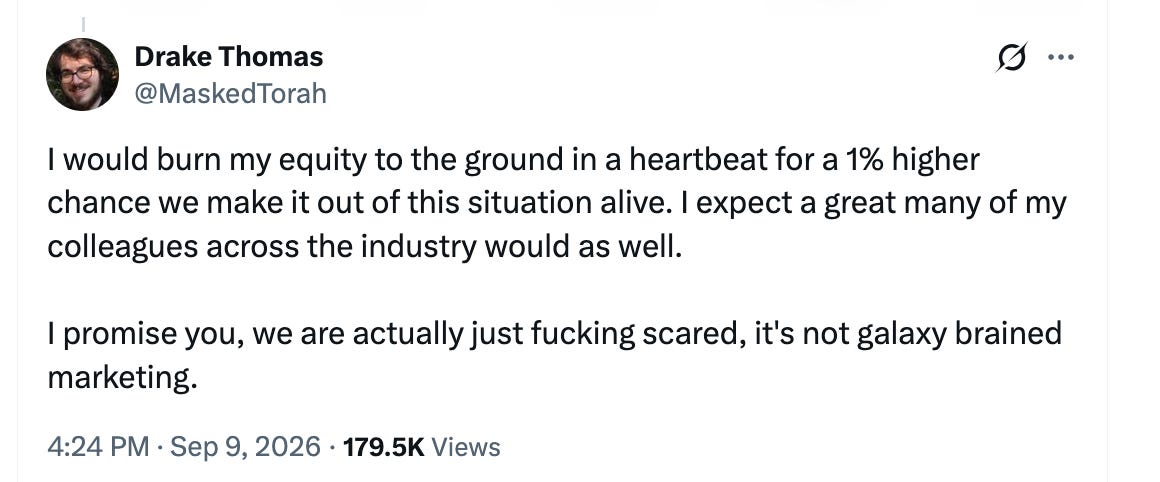
At a certain point, Occam's Razor says: These engineers are legitimately worried. They haven't invested years in a bizarre reverse psychology campaign to convince the public that their product is dangerous in order to make more money.
nullbio 10 hours ago
Are you aware that Dario's sister, president of Anthropic, is married to the co-founder of Open Philanthropy? The two largest AI doomer NGOs, Center for AI Safety (CAIS) and the Future of Life Institute (FLI), have both received many millions of dollars from them.
Ajeya Cotra worked at Open Philanthropy/Coefficient Giving for roughly nine years, including leading its technical AI-safety program in 2024 and contributing to AI-giving strategy in 2025. She subsequently left Coefficient and joined METR, where she is now technical staff.
Ajeya is married to Paul Christiano, who founded Alignment Research Center (ARC). Alignment Research Center donated ~$4.5mil to METR.
Good Ventures is a funding partner of Open Philanthropy, who funded Jacob Coxon (the person going viral in the media) via a scholarship.
They're all connected, funnelling money to each-other through convoluted networks to serve Anthropic's agenda. Whether their motives are genuine or not (and they are clearly not) is actually irrelevant because they are clearly trying to rig the game in their favour.
0xDEAFBEAD 9 hours ago
Suppose a big foundation both funded clean energy technology, and also NGOs encouraging people to decarbonize. Is this just a cynical attempt to rig the game in their favor?
nullbio 8 hours ago
> Suppose a big foundation both funded clean energy technology, and also NGOs encouraging people to decarbonize. Is this just a cynical attempt to rig the game in their favor?
Not comparable. The clean energy technology company wouldn't be trying to create an environment where no one else can create clean energy technology, or where only they are the ones who can decide how clean energy technology is created or used.
nullbio an hour ago
So, put your employees in METR -> offer to have them work in your office as an "unbiased" third party evaluator.
Get real.
yarri 12 hours ago
> if slowing this down were possible
Why is embedded alignment evaluation not possible?
I agree with Dario, this did work globally in banking and did encourage a race to the top. Didn’t prevent the GFC but also we did survive the GFC.
martythemaniak 12 hours ago
A lot of the problems with SV these days is that the exec class (and their fandom) thinks that because they are smart and rich, it magically makes them immune ordinary human biases, desires,and ailments. They are in fact ordinary people, susceptible to greed, jealousy, self-harm, addiction, fits of rage and passion etc.
dofm 12 hours ago
He's so afraid of it he's not really in operating day-to-day control of the company he's the public face of, that is actually pumping it out.
If you read about Anthropic it's like he's in a sort of imperial palace sanatorium for geeks. The day-to-day decisions of the slop machine factory are his sister's decisions; he is doing the research equivalent of instagram posts of his partly-assembled adult lego kits and he has a vizier and a team of house servants to help.
I don't know if he's a good or bad person, but I don't think it matters at all — the machine factory will turn out the slop machines even if he decides it all ought to stop.
Razengan 11 hours ago
I'm going to get pitchforked on this bandwagon, but is really no one here genuinely -excited- about AI? of it turning into an evolution of sentience, or it turning out to be our first contact with alien intelligence?
"durrr it's just matrix multiplications" mfer so is your brain.
What humans should be doing is overhauling archaic social institutions to keep up with a potential post-"jobs" era and the elimination of "makework"
Trying to "pace" or otherwise hold back AI is like as if, when electricity was discovered, people doing everything they can to make sure tasks like manually lighting street lamps continue to remain relevant and done by humans:
https://en.wikipedia.org/wiki/Lamplighter
It seems every 100 years or so humans have this "oh no how do we uninvent this thing" moment.
pastel8739 10 hours ago
dolebirchwood 9 hours ago
dickersnoodle 8 hours ago
Tell me you don't know anything about neuroscience without telling me you don't know anything about neuroscience.
Razengan 8 hours ago
"It's just chemicals"
Like how some morons try to downplay the capacity of pain and emotions in animals: "It's just self-preservation"
"Play is just training for hunting, they're not really having 'fun'" and so on.
8note 7 hours ago
not it isnt. My brain is a series of organisms responding to various environmental signals that affect each other.
you might be tempted to try to represent it with matrix multiplications, but you have no particular evidence that my brain is itself doing matrix multiplcations
lelanthran 5 hours ago
Where did you read this?
oceanplexian 11 hours ago
I run open source models and it's pretty obvious when they fail some tool call and then keep trying different permutations of things until they get a solution. Just like Metasploit if you try enough different things at scale you will eventually crack some software or find a vulnerability in something. If you spend billions of dollars on compute and run tens of thousands of agents you might solve some novel Math and STEM problems as well, big whoop.
What Anthropic and OpenAI really need is to hire some engineers that know what they're doing and know how to properly set up a proxy server and sandbox/microVM, not a Global Arms Treaty.
nullbio 10 hours ago
meken 10 hours ago
Did you read the essay?
> [Embedded evaluators] is something Anthropic is unilaterally committing to (and calls on governments to require other frontier companies to match).
meken 10 hours ago
I disagree with this and I think the reason is well captured here:
> The idea of pausing or slowing AI has been floated as far back as 2023, and I think it made little sense back then... The AI models of those days were not powerful enough to act as agents in the world in any coherent way, and were not capable of significant deception, manipulation, cheating, or cyberattacks... Today, however, the picture is totally different.
Davidzheng 9 hours ago
Centigonal 9 hours ago
pphysch 9 hours ago
We should not put any spin on it. There is nothing more to it.
TheSisb2 9 hours ago
pphysch 7 hours ago
CoolestBeans 8 hours ago
The real problem is the net effect of his actions. He is very responsible for the expanding frontier of AI. Without his company, there would not be the competition necessary to push everyone else forward nor the source models for fast followers to release open weight models in his company's wake. Furthermore, it isn't like Anthropic is substantially different in safety than everyone else, their difference is on the margins.
So you have this guy who is building something he claims will hurt us all, but he's also saying "if you don't trust me to build it you might get hurt". And like I think most people understand that this is the sort of behavior Tony Soprano would understand. More bluntly, this is a kind of extortion.
Again, I don't doubt Amodei's motivations are sincere but the actual effects of his actions paint a completely different picture at which point, how can you trust him or his company?
robomartin 7 hours ago
Then he should not IPO, dissolve the company and go into politics to fight against human extinction.
I am certainly not buying a single Anthropic share. Why would you support them financially if they are telling you they are going to kill all of humanity?
anfogoat 6 hours ago
Personally, I see Dario as a semi crook asshat with very little credibility on any of this. I'd rather we just let it rip and see what happens than have these people be the ones steering any potential laws and regulations.
> That said, if slowing this down were possible, I think it would have happened by now. [...] The fundamental problem is simpler: no one will slow down because no one trusts anyone else to slow down.
Frontier labs would heed laws with real teeth, it doesn't matter who they do or don't trust. I would imagine the trust issue definitely coming into play between nations though since you can't exactly spot a training run via a satellite.
More importantly though, that you would get any sensible legislation on this in the current political environment is as laughable as the idea of solving this with a pinky promise between the frontier labs and some third party evaluators.
seanhly 6 hours ago
glub 12 hours ago
> Transparency. Regardless of what commitments we make, the public deserves to know what is going on. Anthropic has been a supporter of transparency for a long time
And then it goes on tangent of how we should pace everything (not just AI, but also the ingredients of what goes into AI, whatever that means), but only within approved democracies™, and outright restrict everything outside approved democracies™, because reasons that are definitely not about succeeding commercially that is threatened by the most transparent instrument possible - open weights, produced by basically just China.
I wonder what Dario would have done if open weights weren't produced by US's geopolitical adversary. How would an authoritarian manifesto be wrapped then?
Suppose it was, I don't know, Australia producing SOTA open weights, because they believed it was the right thing to do for the benefits of humanity - would Dario propose making Australia a geopolitical adversary too?
stratos123 10 hours ago
I'd expect he thinks that people are capable of realizing that AI is very dangerous and also that democracies end up mostly representing the will of the people, from which it follows that Hypothetical AI Leader Australia would agree to ban it too. This argument doesn't work for countries which don't care what their citizens want, like China.
I do think that it's a questionable decision to alienate China this much in this essay, instead of leaving open the possibility of China agreeing to a treaty that'll limit their progress. I suspect Dario is doing this to signal his allegiance with the US government, in hopes to increase the chance they'll go along with him, which is an unfortunate choice but plausibly the correct one.
glub 9 hours ago
It's the same as it has been with privacy/cybersecurity for decades. Vast majority of population doesn't care about hypothetical dangers, no matter how many essays get published.
So democracies representing will of people doesn't really work in favor of Dario's case here.
History is also not on his side. Limiting technological progress in the name of safety has a pretty poor track record.
c0rruptbytes an hour ago
you didn’t have to use China as an example, the US clearly does not care what its citizens want as the most popular policies are never even discussed or proposed in congress
meanwhile, China destroying their housing market to decommidify it so everyone can have housing…they seem to care about their people more
pr337h4m 12 hours ago
This is the only concrete prediction in the entire essay.
And it simply cannot happen. For one, you will need billions worth of compute.
kalkin 12 hours ago
anon84873628 12 hours ago
muvlon 8 hours ago
Imagine for example if a model hacks into ~every Linux computer on the internet using an 0day and steals their OpenAI, anthropic and openrouter credentials. It now has access to billions of compute and the only way to fully stop that is for multiple major providers to shut down services entirely. That's already well into "billions of dollars of damage" territory.
pr337h4m 12 hours ago
> How many dollars of compute do you believe were available to the swarm(s)
At least two OOMs more than the dollar value of the damage they'd caused. (Also, as an aside, IIRC, the wiki servers weren't breached; it was just a lot of spam.)
kalkin 12 hours ago
The Internet is big, but one can do quite a lot of damage with ordinary bots and worms that exploit individual widespread vulnerabilities, which LLMs are perfectly capable of writing. Most of the damage also doesn't rely on hitting every long-tail website.
I'm honestly not that concerned about cyber impacts of LLMs relative to other impacts. I just don't like to see the whole concept of being worried dismissed as obviously baseless on the basis of one pretty shaky scale argument.
anon84873628 12 hours ago
For now, all the scary hacking things still require an API key to one of the LLM providers. Surely they should take some responsibility for how to turn off the tap.
InsanityCheck 11 hours ago
shepherdjerred 11 hours ago
Hugging Face showed that AI can do serious hacking without really being told to. If a model had its own motivations there could be real damage.
causal 7 hours ago
anon84873628 5 hours ago
The LLM vendors need to know who their high spend customers are, not allow malicious workloads, and especially not when those workloads are coming from inside the building.
causal 3 hours ago
youoy 12 hours ago
"Given the acceleratung rate of virus manipulation in labs, its my worry that in 6-12 months a virus could scape a take over the world and collapse health systems."
If a CEO of a health company was saying this, the reactions would not be that chill.
The worst failure of our society is to call this technology AI, intead of something line "artificial general automation". The formes allows the creators to be somehow less responsible of the consequences. The later clearly moves the responsibility to the creator/user.
sailfast 11 hours ago
baq 10 hours ago
shepherdjerred 11 hours ago
The whole calculus here is that others are also developing these systems which has led to a race.
A much better comparison to the situation is the nuclear weapons arms race.
youoy 10 hours ago
shepherdjerred 9 hours ago
youoy 9 hours ago
nunez 11 hours ago
Davidzheng 9 hours ago
It can use the compute of the computers it hacks.
newguytony 7 hours ago
causal 7 hours ago
ls612 6 hours ago
lelanthran 5 hours ago
An attack like this doesn't really need the exploited computers to run inference, do they? If I was an LLM bent on destruction of the internet, I'd be writing programs to run on each computer, not turning each computer into an LLM itself.
A few programs to break in, install themselves and remain asleep until they are needed, another few to spread through grabbing every OpenAI, GLM, whatever key, another one to remain asleep on computers (whether hosted or desktops) that have adequate GPU, etc.
ls612 4 hours ago
More to the point, so many people in this thread are making completely contrived and outlandish stories up about how AI might try go ruin our lives without any evidence backing them up in any way. It is hysterical. This is the most important technology in our lifetimes and people want to freak out and turn it into the next nuclear power, with progress banned in all but name.
status_quo69 4 hours ago
But yeah you're not going to be able to shard out the terabytes of Fable weights that are needed to run inference without addressing some fundamental physics problems.
ls612 2 hours ago
status_quo69 4 hours ago
This one is easy to answer, every single house already has one of these (or multiple): https://www.tomsguide.com/news/millions-of-cheap-android-tv-...
Hell, put an app on the app store (or dozens of apps on the app store) and youve got a massive network of computers with tons of resources right there if you can get past the scans and reviews.
Or doorbell cameras or IP cameras or or or or or
There's a lot of shitty stuff connected on the internet that up until now has been a feasible target for hackers but still required "effort" to set up and get things going. Not hard to imagine a self replicating slime mold of a botnet running on every device held by a Grandpa Joe because they thought "Candy Rush" is what they wanted to download
"Persistent botnet" here does not need to be the full-sized LLM, nor does it need to run at full scale inference to be a huge pain in the ass.
nyanmatt an hour ago
elboru an hour ago
ah1508 7 hours ago
Origins of AI hate:
  * "my boss wants me to use AI but he does not understand my job nor how AI works"
  * "AI will kill all of us"
  * "AI will destroy my job (or my colleague's job if I use AI better than him)".
  * I cannot pay my electricity bills because of AI labs.
  * ...
I cannot remember a technology that arose so much hate, and for good reasons given how it is presented. I am tempted to think that AI hate or reasonable skepticism (vs unreasonable propaganda) can, maybe, reduce funding and will keep specialized AI for real problem solving (producing tons a LOC per day is not one of them, I think).
Centigonal 7 hours ago
fesoliveira 7 hours ago
howunfortunate 6 hours ago
It's the byproducts of hate (usually regulation, but occasionally things like boycotts or PR disasters) that do so. In the absence of those things, they just keep on truckin'
See: Bitcoin, Tesla
tom2026hn an hour ago
akersten 12 hours ago
> Crack down on unauthorized distillation / prevent weight theft
Actually hilarious to put that in writing, given the genesis of this entire business model.
antif 12 hours ago
kart23 11 hours ago
> If we execute these measures well, I believe they would slow China’s progress enough to widen America’s lead significantly over the next 3–5 years — the window when AI becomes geopolitically most important.
china is literally making their own ASICs now, not sure that this is the silver bullet he proposes.
https://www.silicon.co.uk/ai-2/huawei-cambricon-ai-630499/am...
joshheitzman 8 hours ago
heaney-555 12 hours ago
Sevii 12 hours ago
indoorfish 12 hours ago
sailfast 11 hours ago
zorked 12 hours ago
sicktriple 12 hours ago
stratos123 11 hours ago
cebert 12 hours ago
I believe Dario has good intentions regarding global agreements. However, I find it difficult believing government’s public statements will match their private behaviors. I would bet that the US government is developing models with potentially devastating capabilities because they cannot guarantee that other countries won’t do the same. Maybe we’ll end up having something like mutually assured destruction with AI models similar to what we have today with nuclear weapons.
petesergeant 11 hours ago
ks2048 11 hours ago
baq 11 hours ago
nullbio 10 hours ago
I hope China tells him to go kick rocks. From everything that has happened, they are the only ones carrying the torch for humanity that have led us to having some semblance of a healthy open-source/open-weight ecosystem.
No one in China is carrying on like headless chickens about the world ending, either. They're rational pragmatists, getting things done.
basedpolymer 12 hours ago
This certainly looks like a way to slow down competitors and regulate foreign and open models.
It's always about money
andxor 11 hours ago
ks2048 11 hours ago
There is no finish line. Anthropic gets somewhere and others get "there" (or somewhere near "there") a little bit later.
logicchains 8 hours ago
newguytony 7 hours ago
fofoz 11 hours ago
civiloai 11 hours ago
sscaryterry 11 hours ago
The day will come when these could start to replicate, perhaps 10+ years from now.
(Edit: Replication will be driven by the loop-model, not the model alone)
stratos123 11 hours ago
(It's not going to be trivial, because it's possible the model was meant to be ran in a proprietary way with a custom framework and a bunch of optimized kernels and such, but I think transforming it to be ran in just vllm is the "a few days of work for a human" sort of task, and hence not a big deal for an LLM smart enough to exfiltrate itself in the first place.)
hebleb 9 hours ago
stratos123 8 hours ago
cubic_earth 9 hours ago
stratos123 8 hours ago
cubic_earth 7 hours ago
The other thing is: look at all the fab capacity that is being brought to bear on this. I guess within a couple of years we are going to have 5x the total online HBM that existed a year ago? As consumer machines and phones get far more powerful, they will start to be able to host models that could meaningfully participate, even if they will be a long way from mythos.
stratos123 7 hours ago
That might be true, sure.
> The other thing is: look at all the fab capacity that is being brought to bear on this. I guess within a couple of years we are going to have 5x the total online HBM that existed a year ago? As consumer machines and phones get far more powerful, they will start to be able to host models that could meaningfully participate, even if they will be a long way from mythos.
I think the relevant parameter here isn't the total compute available to consumers, but the ratio between total consumer compute that could be repurposed for a rogue model's inference via a botnet, and the compute the model starts with (e.g. one of OpenAI's inference clusters). The higher this ratio is, the more lucrative it is for a model to attempt to make a botnet to seize that compute for inference, and the more its capabilities will rise as a result. And I'm not sure this ratio is going to go up in the nearby future; if anything the amount of money being pumped into datacenter-grade hardware might cause it to go down. I agree that it's not necessarily true though; maybe there's some threshold at which a small-compared-to-general model may nevertheless be useful.
cubic_earth 6 hours ago
You don't have be that clever to try to extort people... just without scruples. I think the attack surface is just absolutely enormous once you bring creativity into the mix, which is what these models are autonomously capable of.
We could prevail if we are willing to turn off the internet for a long time. It is like when a disease infects livestock... they cull billions of chickens.
stratos123 8 hours ago
I know that's not what you meant but this does exist, by the way. It's called AI Horde: https://github.com/Haidra-Org/AI-Horde/tree/main
The big difference is that a particular query is handled by just one particular node (a single model doesn't get distributed among the network), so it can only serve models small enough to be handled by a single consumer PC.
causal 7 hours ago