

GLM-5.3 is now open-weight (huggingface.co)
634 pointsby jeudesprits14 hours ago218 comments
revolvingthrow 13 hours ago
GLM 5.3 is probably the sweet spot open weights model if you want to go beyond deepseek flash or the new glm flash. I used it with pi and had a fairly good time, especially since it’s less touchy about cyber and whatnot than the US guys. It’s slightly behind Kimi in ability but it’s a lot easier to run it, I’d expect prices (and speed!) from third parties to be noticeably better.
Assuming you’re willing to drop a fat stack of cash on the upcoming Mac m5 ultra with 512 gb unified memory, you can even run it locally, quantized to 4 bit. Whether it’s even slightly reasonable, well, my wife would probably skin me alive but maybe yours is more understanding.
walrus01 13 hours ago
One could also run it locally on a used dual xeon (or amd-equivalent) server with 512GB RAM, albeit slower, if you have a useful workflow for it that's like "take this day's efforts and run it through various analysis agents", combined with giving it one-shot tasks/modules to build overnight. You would want a place like a garage or basement to put the server because it'll be loud.
dataplumb3r 13 hours ago
You'd also likely spend far more in electricity than the API cost of processing the prompt(s)
walrus01 12 hours ago
yes, though for some uses, not sending data anywhere to third parties has its own value which is harder to measure.
peri-cl 12 hours ago
> "dual xeon"
Does inference make full use of the memory bandwidth in a NUMA system?
walrus01 12 hours ago
Memory throughput performance is better than many equivalently priced (talking about the cheaper end of the used/refurb market here) single socket systems because each CPU is talking to its own banks of RAM.
Using an example of llama-server on a 256GB (each CPU is attached to 128GB) system running qwen 3.8-flash-next Q8, which takes up about 188GB with the model and context, it's not that the inference engine 'knows' about NUMA, but if you use --load-mode mlock to load the whole thing into memory at once at the time llama-server launches, the kernel will distribute it relatively evenly across the memory connected to both CPUs.
0xdeadbeefbabe 13 hours ago
Well if you did get the m5 ultra could you obliterate the guardrails and then your wife can ask it pertinent but unsafe questions about how to punish you. Seems doable.
lnenad 13 hours ago
I have just built an Epyc with 512gb DDR4 3200 RAM for a "reasonable" price and I'm hoping to have a setup with GLM as the architect and Qwen 27b/Next Flash as the implementer. This is 1/5 of the price of the Mac, but also probably 1/5 of the speed lol.
jchw 13 hours ago
Honestly I suspect neither of them will be performing terribly well but with DDR4 3200 RAM I wonder if you'll be counting tokens per second or seconds per token. I mean, you do at least get a lot of memory channels at least, compared to consumer PCs. I am curious to hear what performance you get, I feel there is not enough information out there on what different setups manage to eek out.
Philpax 12 hours ago
The fastest I was able to get my Threadripper 3960X + 2x 3090s + 256GB DDR4-3200 to run a 2-bit quant of GLM-5.2 was 8 TPS. I would expect to be in seconds-per-token territory for a pure-CPU 4-bit quant.
jchw 12 hours ago
One thing I'd like to try is MoE offloading: I have 2x32 GiB of VRAM and 128 GiB of DDR5 running at 4800 MT/s (only 2 channels though). I've seen people post difficult to believe MoE offloading results albeit a decently long time ago with older models. Maybe there is a quant that would fit with MoE offloading?
That said, I am guessing my problem is not enough RAM - but this poor consumer platform struggles to do memory training with 128 GiB as it is.
Now I surely regret not having gotten Threadripper and 256 GiB of RAM in the before-times.
Philpax 12 hours ago
My measurement was with MoE offloading, but there's only so much you can keep on-GPU with a 200GB quant and 48GB of VRAM. It's hard to overcome the CPU/RAM bottleneck.
For what it's worth, all of my hardware was used; I think, all-in, I'm probably at around 3k-4k USD? Not cheap, but also not the worst for something relatively versatile.
jchw 11 hours ago
Ah, I see - so MoE offloading is no savior. A shame but no surprise either.
snerbles 12 hours ago
With a 4-bit quant of GLM-5.2, I can get about 0.8-1.1 tok/s on an underclocked dual Xeon E5-2698 v4 with 512GiB of DDR4-2400. I think it was specifically a Q4_K_M quant. Of course, the time-to-first-token is absolutely atrocious.
Which is completely insane for a ten year old configuration.
lnenad 9 hours ago
What model are you interested in? DS Flash 0731@Q4KXL I'm about 25-30tps. Same as the new Qwen3.8 Flash Next. The new GLM 5.3Q3KXL at 10tps. I've got 2x3090s which I didn't mention in the original message.
0x457 12 hours ago
Depending on which Epyc you got it might be slower than 1/5 of the speed.
lnenad 9 hours ago
48c 7643. I'm getting about 10tps @Q3kxl with 2x3090s.
nazgulsenpai 12 hours ago
Curious about that price, if you don't mind sharing a ballpark
lnenad 9 hours ago
About 5k with RAM and GPUs bought used. Eastern Europe.
springtimesun 12 hours ago
I’ll be very curious what you get with DDR4. I also almost went that way. I have an Epyc DDR 5 rig and the best I see is 10 tok/s. Caveat being that’s at Q8 and a 4090 doing pre fill so it could be pushed up.
The surprising thing for me is how much work you will need to cool the banks if you’re near your memory ceiling. My memory starts soft throttling at about 74C (dies may be hotter, that’s the bank temp) and will turn down speed to try to stay below 80.
Happy to send my llama.cpp config settings if you want it.
pdntspa 11 hours ago
I was running one of the older llamas (3.1 I think?) at slow-ish (10-20 tok/sec at Q4?) but OK speeds on 12 year old DDR3 ECC Xeon machine
springtimesun 10 hours ago
I find 10 to be very usable. It’s not (that) interactive but it chews through tasks. I let Kimi churn away at 4 overnight and it gives good results that are ready for me in the morning.
lnenad 9 hours ago
I am getting 10t/s on unsloth's Q3kxl with 2x3090s@250w. It's enough for me for now. I will probably upgrade the GPUs down the line. DDR5 would have made the price of the machine double and I just wasn't prepared to pay that much.
Temp wise, no throttling, surprisingly cool.
pixl97 an hour ago
Typically computers with these larger memory amounts have fans that scream like a banshee trying to move impossible amounts of air over the memory and CPU. Getting something both cool and quite can be a bit difficult.
guybedo 11 hours ago
I have a dual epyc + 1TB RAM.
I could push glm 5.2 to 7 tok/s CPU only.
fsuts 9 hours ago
It’s not unified ram? I.e VRAM so it will struggle
lnenad 9 hours ago
I'm getting about 10tps @Q3kxl with 2x3090s.
sickcodebruh 12 hours ago
When we consider:
* LLM usage is new for the world
* Models are evolving quickly with high worldwide competition
* Hardware is evolving despite RAM shortages
Is investing a huge sum of money in equipment for local inference a wise use of money? Or are M5 Ultra and equivalently priced local inference hardware future-proof enough to be worth it relative to how the market is evolving? Maybe it’s all a question of what you’d spend otherwise on serverless or dedicated GPU spend…
rkangel 12 hours ago
It is absolutely not worth buying hardware to run models for purely (long term) cost reasons. For open weights models the economies of scale means the cloud beats local significantly and your payback time is like 10 years.
However there are other reasons (e.g. privacy) that might make it worth running locally for some people.
WASDx 8 hours ago
I think the privacy argument that keeps coming up is overrepresented. Certainly ZDR is enough for an absolute majority of use cases? I see so much talk about local inference but I doubt most of it has privacy as a valid argument (not arguing it doesn't exist). It's fun to do things locally though. I've tried it as well but cloud is just faster and cheaper.
rkangel 8 hours ago
These companies have displayed zero respect for everyone's intellectual property getting these models trained.
I think not giving them your complete trust is reasonable! I'm not saying zero trust, and ZDR is fine for most things but I understand the people who don't want to stream their whole codebase out token by token.
WASDx 7 hours ago
Then use other providers hosting open models. Companies and individuals already put their whole code base on the cloud. I'm genuinely interested in privacy-oriented use cases where ZDR is not enough.
Gigachad 7 hours ago
I'm not that worried about the codebase itself. I'm worried about the fact coding agents poke around the terminal and system so much that there is almost a certainty that some of your other personal data ends up in the context somewhere which is getting logged in to a training dataset by random hosting providers.
applfanboysbgon 7 hours ago
ZDR is built on trust. Given that end-to-end encryption fundamentally doesn't work with LLMs, as they need the content to be unencrypted to operate on it[1], you have no way to prove that once your plaintext data is on somebody else's server they aren't doing whatever the hell they please with it. All you have to rely on is their pinky promise that they won't do anything with it. Trust is a valid option, much of our society runs on trust, but you can eliminate the need for trust whatsoever by running on your own hardware.
[1] Yes, I'm aware of experiments to operate on encrypted prompts, but these are only research attempts, not something that could actually be used with frontier models in production.
elorant 6 hours ago
Privacy isn’t only, I don’t want anyone to have access to my data. It could also be, I don’t want anyone to know my use case because it’s niche and highly profitable.
joemazerino 7 hours ago
And compliance.
jaggederest 7 hours ago
I think the biggest reason is to own the stack so your model can't be changed out from under you, but maybe I care about that too much.
zackify 6 hours ago
You do, there's like 20 providers for any model on openrouter. You can also just spin bedrock or gcp and download the weights for later if you're worried. It's never going to make cost sense when the token rate is so low with how expensive ram is
jaggederest 6 hours ago
What if the internet goes away?
Aurornis 6 hours ago
> I think the biggest reason is to own the stack so your model can't be changed out from under you,
The concern would be future regulations that prohibit you from buying a hosted version of the model. Even that could be bypassed with a VPN to another country but it's more work to go through the payments.
As long as there is demand for a model, it will be hosted by multiple providers.
jaggederest 6 hours ago
What if the model is hopelessly obsolete, and thus no demand, but I want that specific model? Owning the weights and hardware is not just solving for one problem. It eliminates all the classes of problems that occur outside of your building, if you have a solar and battery setup.
Also, on a more practical basis, what if the way it's served is bad. Maybe I want my specific KV setup, or ultra low quant for entertaining garbage at 200 tk/s
jaggederest 5 hours ago
Also, this makes me wonder if, by using a bicycle generator, and a local model at sufficiently low power consumption, you could directly claim to have produced the text in a really physical way. "Yes, I generated the electrons that made that text work by my own efforts".
Aurornis 4 hours ago
> What if the model is hopelessly obsolete, and thus no demand, but I want that specific model?
You can still find a lot of old and completely outdated models on OpenRouter. The providers can scale serving of models up and down as demand arrives, so models don't generally disappear. They're just kept in the mix and the clouds will allocate hardware to it if someone is willing to pay.
In the odd case that it disappears completely, buying the hardware 2 years from now is probably going to be a better deal. That wasn't true if you selectively check the time period before hardware got expensive, but as new hardware comes out we're going to start seeing Strix Halo and old Apple hardware hit the market as people upgrade. It's already happening.
There is a certain personality type that cannot tolerate any uncertainty and must lock everything in right now against all future possibilities. If you fit that description then there's nothing anyone can say to discourage you from buying your own hardware, but for everyone else I do not recommend buying hardware to self-host LLMs just to save money. I self-host and run a lot of tokens through my setup (non-coding work) but I'm not really saving money.
jaggederest 3 hours ago
> There is a certain personality type that cannot tolerate any uncertainty and must lock everything in right now against all future possibilities.
I thought HN banned personal attacks. I'm in this sentence and I don't like it. /s
I just buy the good apple hardware because it's good, and it also happens to run local models. It's not as good for the dollar, don't get me wrong, but I'm not going to develop iOS without a mac, that's even more questionable than buying a strix or whatever.
icedrift 2 hours ago
The only reason I'm considering picking one up is I think we're not that far away from compute limitations in consumer hardware.
2Gkashmiri 2 hours ago
I live in a place where using VPN is illegal and akin to "terrorism" because why would you want to hide what you are doing. Only bad guys hide. So if you use VPN, you are a bad guy.
https://srinagar.nic.in/notice/immediate-suspension-of-virtu...
Phones are randomly searched on the streets and if VPN is found, arrested
https://www.medianama.com/2026/01/223-jammu-kashmir-vpn-ban-...
https://timesofindia.indiatimes.com/india/after-vpn-ban-in-k...
“Out of the 15 individuals identified, five were minors who were counselled and advised in the presence of their guardians, with emphasis on awareness, lawful digital conduct, and the consequences of violating lawful orders,” he added.
solarkraft 11 hours ago
So far I don’t regret buying an M1 Max device with 32Gb of RAM. The models available for it keep getting better (running just about okay for interactive use) and 400 GB/s of bandwidth is still considered a lot.
The models are currently improving much faster than the hardware and this doesn’t seem to have plateaued yet.
frigidwalnut 11 hours ago
Cool! I'm thinking about a local set up. What's your usual tokens/second rate?
victords 9 hours ago
Not OP, but I’m running local models on a M1 Max as well with 64GB RAM.
It varies by model, but I’m getting 50-60 t/s with Qwen 3.6 35B and Qwen 3 coder 30B.
I’ve also used Qwen 3.8 27B but I get 10t/s on it.
It’s useable in some use cases, but I rely mostly on my $20 Claude subscription.
copperx 6 hours ago
That's so cool. I wonder if the regular M5 can run those models too.
lenerdenator 11 hours ago
That's basically the question I'm trying to answer.
If you're paying Anthropic or OpenAI to use their models, harness, governance, etc., I could see the local inference potentially coming out ahead. They're already starting to ratchet down what your money gets you on their platforms, and that can be expected to continue as the leaders of those companies continue to seek the road to the El Dorado that is being a trillionaire.*
If you're looking to get into the guts of AI development instead of having it handed to you by a provider, that's where it gets murky. I'm wanting to write some sort of agent that does things and get into making outputs consistent in the like, and I'm not sure whether to host something on GCP or buy an M5 Mac.
*Note: El Dorado is a mythical city and many people died trying to find it.
sneak 11 hours ago
Part of it is knowing that whatever sort of enshittification the cloud providers do, my local programming environment won’t ever be less effective than it is today locally. It’s the same reason my entire development stack from editor to compiler is open source. I don’t need to modify it today, but I always must retain the option to do so later.
There are several things I do in my life that only pay off in the event of a big disaster, like an extended internet outage, civil unrest, supply chain disruption, war, etc.
I like to be able to do the things I do even if offline for weeks.
I spent a lot of money for more flash in my iPad Pro so I can keep all of offline wikipedia and OSM in it, for example, along with tons of books. It’s sort of like being a digital prepper. (Being a prepper is a spectrum, from anyone who keeps food in their pantry to people building bunkers under their house - how much you invest is a personal prudence and threat modeling decision.)
Also, privacy. And when I got the Mac Studio the 512GB was only $15k, which is dirt cheap for that much VRAM.
Frost1x 10 hours ago
> Part of it is knowing that whatever sort of enshittification the cloud providers do, my local programming environment won’t ever be less effective than it is today locally.
Is that true though? Many of the core LLMs need to be retrained as languages evolve to incorporate changes (language specifics, compilers, tooling, etc.). To some degree this can be handled via context injection in a variety do forms (agents looking up documentation and so on) but inevitably it’s not stationary in time, just as your OSS stack (probably) isn’t (depending on the languages, technologies, and use cases).
So your hardware is to some degree dependent on the good merit of groups like Z or Alibaba or whomever pushing out updated open weight models that dumped loads of capital into to train. You can keep using the existing models but at some point I suspect they’ll start to have more friction due to dated specs in language and so on. Again there are tuning and ways of layering this information on, and in theory you can even do some training on your own but I don’t think it’s as stationary as being portrayed here.
Those updated open weight models may not always be there (updated on new data). The usability of them is probably fairly long to be fair, but I suspect you’re going to see explosion in everything from libraries to languages etc due to LLMs so even the rate of change across your OSS stack may cause these models to be dated quite quickly, at least in the core model which will require layering fixes.
To be clear I’m on the fence thinking about much of the same issues and as close as I am to pulling the trigger, I keep thinking of very valid counter arguments as to why it’s me just wanting this thing I own. Which may be enough.
Phemist 6 hours ago
With every newly released open weight model, the clock on the issues you describe is reset. I can see a marketplace arising for paid updates to common lines of open weight models, which will incentivize those with the hardware to train to fix the problem for those who only have the hardware for inference.
I would say when this comes to pass, we are already 5 years along?
> Part of it is knowing that whatever sort of enshittification the cloud providers do, my local programming environment won’t ever be less effective than it is today locally.
I think this is quite understated. It basically is freedom from a growingly antagonistic relationship between you and some remotely hosted API managed by faceless corporates at the whims of their board, shareholders and governments.. It really is such a mental burden to need to constantly manage this relationship (watermarks, silent downgrades, random false refusals, downtimes, model sunsets, changing ToS's, fucking ads). These companies will need to squeeze you for every cent that they can before open-weight models are simply good enough for the valuable tasks we can throw at them.
To have your own hardware is to no longer have this mental burden.
anarticle 11 hours ago
Tools vs services in my mind. There is no guarantee any provider will continue to do what they are doing for you at the price they are doing it.
The object permanence of not having to reinvent the world every time a model gets sunsetted has value.
andriy_koval 10 hours ago
> Tools vs services in my mind. There is no guarantee any provider will continue to do what they are doing for you at the price they are doing it.
with open models, there is ecosystem/market of providers, where you can easily switch to provider you like
stymaar an hour ago
Until there's an executive order that blocks one model from being served.
ewwefwef 10 hours ago
Do You have guarante any electricity price?
Zambyte 8 hours ago
Maybe not them specifically, but for many people with solar as an option, yes.
mirekrusin 9 hours ago
With competition we kind of have guarantee up to what providers can do, they don't have that much control, the most radical thing they can do is to go bankrupt.
stymaar 9 hours ago
Have you already forgotten the Fable drama that happened just two months ago?
loglog 8 hours ago
Self-hosting won't protect you from getting locked out of a closed weights model, because you can't self-host it even if you have the hardware.
snarfy 10 hours ago
Jalapeno is matching or very near Vera Rubin at 1/4 the power. I would not buy hardware now.
fsuts 9 hours ago
OpenAI have only just announced it and have every reason to hype it up.
Could be a long time till gets released
SwellJoe 9 hours ago
I have a Strix Halo and dual 32GB GPUs in my desktop, that sit idle right now, because the electricity to run them and to cool them in 110F weather Texas is currently experiencing pretty much nulls any savings I might see over getting better models from cloud providers. While I mostly use Claude or Codex with subscriptions for agentic work, for API use DeepSeek has usually been my go to, but now I guess it's GLM 5.3 or the Flash version. And, for security work that Anthropic or OpenAI models are likely to refuse, I've been using Kimi K3 (also via subscription, though their subscription is extremely stingy), but I guess GLM is now the one for that, too.
Anyway, yeah, even at the prices I spent on my local AI stuff (I bought before RAMpocalypse really kicked into gear, so I bought old server GPUs for about $350 each and the Strix Halo for a little over $2k) it was never going to pay for itself; I just like to tinker. But, I can't imagine spending today's prices for hardware for local AI.
When the memory shortage ends, I'll be down to the Apple Store (or, more likely, clicking refresh on the Apple outlet every few days). But, until then, there continues to be a glut of cheap and free models in the cloud that are better than anything I can run locally and they're faster, too.
Barbing 8 hours ago
Too hot and expensive to run right now but a great hedge for peace of mind against $200 subscriptions shooting up to the $4000* they should cost.
*$1000? $14,000? Who knows but everything in the middle there has been claimed.
loglog 8 hours ago
If they "should" cost 4k in the sense of marginal cost, then you will be spending more running the same at home, because your home hardware will always be less efficient.
RevEng 3 hours ago
There is a big difference in the cost of a 5-nines up time system in a heavily space constrained environment compared to a home hobby white box used for some coding. The GPUs alone cost 10x for the data center versions compared to the gaming versions even with similar specs.
The cost of online services is also largely a result of the cost of training (though hard to say exactly what that number is). Assuming you are using open weight models at home, you aren't paying for the training - someone else is.
edg5000 2 hours ago
> The cost of online services is also largely a result of the cost of training
OpenRouter prices are somewhat simmilar to Antrhopic/OpenAI API prices. So I conclude that the hardware plus operating margin alone can genuinely produce prices way above what you'd pay if you had a subscription. Of course the primary unkown factor is average token use per subscription. Without that it's all wild speculation.
SwellJoe 7 hours ago
Yeah, I guess, but it feels like there isn't really an opportunity for anyone to do that, given how competitive the market is. If Anthropic decides to demand API rates for everything (which would make my $100/month turn into a few thousand, I guess), I won't be seriously inconvenienced by switching to GPT. And, if both of the major American providers do a pricing collusion and GPT also becomes thousands of dollars a month to use, I can choose between Kimi K3 and GLM and so on. I'd rather use Opus 5 and Fable, but I'm not going to be seriously put out if I can't. We've got three or four open models to choose from that are as good as or better than Opus 4.8, which is Good Enough, and the competition isn't slowing down. We're seeing more new competitive models more frequently than even three months ago.
So, even though there are more models to run locally that can be useful for the stuff I do, it makes less sense now to do so than it did when I got it. There are more extremely cheap options, now, and it seems likely to continue to get cheaper and better and faster, while my local hardware will always be slow and hot and only gets better via software (which has roughly doubled the speed it can run stuff since I got it, but it seems like there's less room for improvement in software now, and even at twice the speed, it still kinda sucks to use local models interactively especially on the Strix Halo).
pixl97 2 hours ago
I wish Texas would write up a regulation allowing 'balcony solar' as I could easily generate 1000-2000w of solar in my small back yard to take a bite out the sizeable cooling bill I have.
SwellJoe an hour ago
Seems like it's easier to ask forgiveness than permission. And, I wouldn't bet on this legislature ever doing anything that would disempower fossil energy or reduce their profits, even a little bit.
hgoel 3 hours ago
Only reason to spend a bunch of money on hardware to run LLMs locally is if it's a hobby to you to an extent that even renting the GPUs temporarily won't satisfy you.
crossroadsguy 11 hours ago
Its reasoning leaves a lot to be desired :(
Though I appreciate how good it is at "solid" grunt work and at that price (in fact I am paying the grandfathered subscription price; mostly).
I am planning to let go for my Claude AI subscription which I now use only for "planning" and maybe use that via Open Router as PAYG (at to try how it ends up). But god glm is bad at "talking" and "responding" anything prose. Not only quality but it's almost impossible to tune it and make it let go of its habits and biases and enthusiasms which often result in too many too and fro.
So I sometimes wonder at what point that starts becoming the cost and mental hassle. Maybe it's not there for me yet.
colingauvin 10 hours ago
In terms of pure tokens per dollar, absolutely not worth it.
That said, when I bought my pair of Sparks, the best model I could run on it was GPT OSS 120B. That has an AA score of 24.
Today, the best model I can run on them is GLM 5.3 Flash at Q4, AA score 57. Just still out on GLM 5.3 mixed quant.
So from that perspective, they are many times better value than when I bought them, and will likely continue to increase in value.
lostmsu 2 hours ago
> GLM 5.3 Flash at Q4, AA score 57
That AA score is for the original model only
epolanski 8 hours ago
I get some appeal of running locally, but isn't it just easier to rent cloud hardware and run whatever model you want to run?
Gigachad 7 hours ago
There's certainly a mental difference between a computer you can use as much as you want for a fixed upfront cost vs a rented server you are being billed by the hour for.
But the cost difference between api and self hosted is so incredibly large now it's almost impossible to ignore the fact self hosting is a terrible deal. I'm waiting things out until the dust settles on what the required specs are and consumer hardware gets cheaper/more capable.
johnnyApplePRNG 8 hours ago
It IS crazy to drop big money on any AI rig right now imho... the size of models and the cost to run them is falling through the floor as we speak.
I'm happy with all of the competition in the APIs on openrouter... I watch that like I used to watch the stock markets, lol. It's great fun.
nkmnz 13 hours ago
I'd like to ask Sam Altman if he still thinks that it's too dangerous to publish GPT-3. I mean, no one would use it, but what is his reasoning for not publishing it now, in 2026?
gruez 13 hours ago
>but what is his reasoning for not publishing it now, in 2026?
What's the point of publishing it when it'll likely be outclassed by gpt-oss?
xscott 12 hours ago
Maybe I'm reading too much between the lines, but I suspect the reason is to rub his nose in the duplicity or naivety depending on how generous you're feeling. Publishing the model would be a confession that he was wrong.
AI policy is being shaped somewhat by the things Sam and Dario say. So even if you're not feeling vindictive, it's probably good to keep a track record of the previous things they have said as a Bayesian prior. People who don't know better listen to these people, and maybe they shouldn't.
gruez 12 hours ago
If you want to dunk on sam for "it's too dangerous to publish GPT-3", you hardly need the release of gpt-3 to prove your point. All the other open model releases already provide pretty good evidence. Moreover the fact that the model wasn't release hardly points to the fact that he wanted to save face or whatever. Most AI labs don't release their old proprietary models, so the fact that gpt-3 wasn't released tells us very little.
nkmnz 12 hours ago
Thank you, I couldn't have said that in a better way.
whimsicalism 11 hours ago
Wasn't the whole point of not releasing because they wanted to normalize the process/concerns for future actually dangerous releases?
I think the release of kimi k3 is definitely arguably dangerous, we're already seeing consequences of elite-tier cyberoffense capabilities.
paxys 13 hours ago
They already publish gpt-oss which is several generations better than gpt-3
bigyabai 13 hours ago
At release, GPT-OSS was arguably a few generations behind the open frontier.
Philpax 12 hours ago
No? They were the frontier, or near it, at the time of release: https://artificialanalysis.ai/models/releases/gpt-oss-120b
cptcobalt 12 hours ago
GPT-3 is a different model than gpt-oss and is therefore not an answer to the question.
I cannot stand using gpt-oss, but I miss some of the creative spark of GPT-3 davinci dearly.
dannyw 11 hours ago
I’ve found a very similar creative spark with Gemma4 base models. You’ll have to do old school prompting, but it’s kinda fun too.
1000xcat 8 hours ago
Reading "davinci" brought a smile to my face. I had forgotten and this really took me back
futureshock 13 hours ago
I think it would be an important historical document as well. We are potentially looking at the dawn of AGI and one of the most important models ever created. Each model is also a kind of ultimate time capsule, containing a snapshot of the entire human collective mind. If you wanted to ask a 2002 person what they thought about future historical events you can just ask them directly.
tough 11 hours ago
> If you wanted to ask a 2002 person what they thought about future historical events you can just ask them directly.
The weights arent the truth tho, maybe a timecapsule-vhs but i wouldnt trust llm weights more than more hardcore deterministic media that might get preserved to infer facts from an era.
The companies doing the training are becoming the "winners" that are "rewriting history" as they train their models.
Breza 4 hours ago
I agree that they are historically important, but if you want to query old thinking in 2070, you'd probably be better off having a modern model analyze archive.org. If that ever goes down, we're sunk.
Philpax 12 hours ago
There are risks associated with releasing historical proprietary models that were not designed for open release:
- It is trivial to extract samples of the training data that was used, which can bolster existing lawsuits/foster new ones.
- Older models are not as safety-hardened, so it is easier to coax unsafe behaviour out of them, which is a PR risk.
- It may be possible to divulge proprietary secrets from the model (e.g. architectural details that may still be relevant).
For these reasons, and more, it's unlikely that GPT-3/similar models will be released until these concerns are no longer relevant (e.g. when they become a purely historic concern, similar to the open-sourcing of other proprietary software from decades ago).
cogman10 6 hours ago
> It is trivial to extract samples of the training data that was used, which can bolster existing lawsuits/foster new ones.
At least to this point, the legal teams could get the model via discovery. IDK that the lawfirms realize that they could get experts (or that they'd have contacts that could) to search the model weights.
seizethecheese 12 hours ago
There’s not such a straightforward relationship between safety and model sis.
According to the book The Thinking Game, lower quality models at that time were considered less safe, because they could be easily tricked into doing harmful stuff. In the book, Dario (of Anthropic) was the head of safety at openAI and was responsible for pushing for 10x scaling in training to make the models safer.
It does make sense, a smart model is going to be way harder to jailbreak into telling me how to synthesize anthrax (or something).
Flavius 11 hours ago
> According to the book The Thinking Game...
According to me, this is nonsense.
seizethecheese 11 hours ago
I mean, none of this is controversial from a historical perspective, people did think that way. Whether they were right about us is another matter.
includenotfound 10 hours ago
Models are quite safe when they're useless, actually.
In the times of GPT-3 I'd scoff at the idea of an LLM doing any hacking; today, I'm running several AIs on my code before publishing, and they are finding (and demonstrating!) RCEs on my localhost server.
For example, one found a missing check in a third party JWT library which allowed full account takeover, which I'd have never even looked at.
Hence I don't believe a single word coming out of these people's mouths. Their "beliefs" are just marketing.
seizethecheese 9 hours ago
From today's perspective, it sure seems like it, probably because increased capabilities have generated a new kind of danger. Back then, they were worried about stuff like the model telling me dangerous knowledge.
I certainly think the labs have muddied the waters using safety for marketing, but that doesn't mean less capable models weren't more dangerous at one point.
includenotfound 8 hours ago
Extremely weak justification on their part, bordering on trolling. It's just marketing.
Easy access to malicious information hasn't proven to be the disaster these anti-prophets proclaim. For the last ~3 decades of widespread internet and search engines, you could trivially find all sorts of information (drug synthesis, explosives, etc.), and we're just fine.
(Corollary: easy access to good information did not make non-intellectual non-curious people smarter. Easy access to information does not have the consequences people immediately assume.)
refulgentis 7 hours ago
There’s this strain of thinking that’s complete alien to me, I can’t interpret what’s being said and it sounds incredibly aggressive. ex. our lead post asking if Sam Altman still thinks GPT-3 is unsafe to release, and I don’t understand what beliefs you don’t believe and who they is and why they’re just choosing to lie for marketing.
My guess is I’m unintentionally refusing implicit signal that you think it’s safe to release all models openly, because you have observed models finding a vulnerability in a JWT library. But that sounds like a straw man instead of a steel man. Idk. :/
hintymad 10 hours ago
In some interviews, OAI mentioned that they didn't think that GPT-3.5 would be a success. They thought it would be a cool toy and they decided to launch it to see how users react. That means that they didn't think GPT-3.5 was intelligent enough. But somehow once GPT-3.5 became a huge hit, people conveniently ignored the anecdote, and started to believe that AGI had been eminent.
armcat 8 hours ago
I am with you 100% but Microsoft (partially) open sourced MS-DOS (v1.25 and v2.0) in 2018, 37 years after its initial release.
z3c0 7 hours ago
Because they would have to reveal their training regiment, which likely formed the basis for versions 4 and 5.
Or did you just mean the weights? If so, the open models distilled from GPT3 should mostly suffice. That's what good "open weights" are.
mmastrac 13 hours ago
I previously posted that DS4Flash was _good_ but not _great_ on two DGX Sparks, but I have to say that GLM-5.3 is pretty amazing. It's been able to tackle all the random hard problems I've thrown at it and it has the intuition that DS4Flash seems to lack.
We're nowhere near a Fable-class model IMO, but things are going to get interesting in this next year.
villish 12 hours ago
What quant are you running and tps?
mmastrac 11 hours ago
NVFP4 ~20-30tps (MTP + vision, no dflash2).
petu 11 hours ago
I assume that's about 5.3 Flash, not full?
mmastrac 10 hours ago
Yes, sorry 5.3 flash.
deagle50 11 hours ago
do you mean GLM 5.3 flash?
VariousPrograms 9 hours ago
It's early days, but GLM 5.3 Flash is the first local model that feels good enough to me to be a "main" model without debating whether each problem needs to be sent to a stronger model. DS4 Flash is good enough at implementing given a plan, but I wasn't always a fan of what it came up with when asked to plan something.
The good news is it can only get better from here.
pyrophane 7 hours ago
> We're nowhere near a Fable-class model IMO, but things are going to get interesting in this next year.
I'm wondering of you could clarify your thoughts on this. I've had a hard time evaluating what Fable-class actually is capable of that sets them (or really it) apart from other models in a very significant way.
boodleboodle 4 hours ago
What coding harness are you using? I am trying to take the plunge and wondering which I should use
armcat 9 hours ago
What's very promising here is the number of tokens-vs-accuracy ratio. I am assuming their "output tokens" means tokens generated as part of thinking and any tool calls (what are referred to as "input tokens" from billing PoV by service providers). The Chinese models like Qwen3.8 and GLM 5.2 are insanely overthinking in our workloads (which are highly complex data analysis tasks). It's a factor of 3-4x over Opus and GPT models. Even with cheaper prices per 1M tokens, the cost ends up being higher, in some cases 2x. So this is very promising from GLM 5.3. Looking forward to trying it.
scosman 13 hours ago
I've been using it more and more. Feels like Opus 4.8, in the best possible way.
jonplackett 13 hours ago
Can you give ant more details how you are you using it? Which harness / service / what you’re building with it etc?
scosman 13 hours ago
z.ai coder plan, both in opencode and direct API access. I use it for my side projects like https://github.com/scosman/Biscotti (on-device meeting transcription and summaries).
MaxikCZ 13 hours ago
> in the best possible way
You implying its better than opus 5?
matheusmoreira 8 hours ago
Pretty much anything is better than Opus 5.
johnnyApplePRNG 13 hours ago
I'm starting to think Opus 4.8 is significantly smaller than most people assume.
If it's significantly larger than GLM 5.3 (I've heard some insane guesstimates out there like upwards of 5T params or more), that would prove rather embarrassing for Anthropic.
scosman 13 hours ago
You can't compare models released 6+ months apart. GLM 5.2 was same architecture as 5.3 and not nearly as good. Takes time to build frontier intelligence and distill down to smaller sizes.
walrus01 13 hours ago
It's not that GLM5.3 in full precision unquantized is any smaller, it's 141 * 5.4GB files at approx 770GB which is about the same size as 5.2.
throwdbaaway 12 hours ago
Hold on.. the routed experts are in FP8 now? Previously they were in BF16. Nice, this shall cut my download time by half!
petu 11 hours ago
This time they just made FP8 "default", accompanied by "-BF16" model/page (previously "-FP8" was released alongside).
jasonjmcghee 13 hours ago
I hear the argument here, but isn't it possible it has dramatically more knowledge and when you get outside the common cases many of us use it for, it'll have completely different capabilities?
I feel like most benchmarks cluster on a reasonably limited area of human knowledge
everforward 13 hours ago
Sort of depends on how well the core reasoning works. It’s not a big effort to connect an LLM to a search provider.
You do pay for the tokens, but in theory on a smaller model each token is cheaper.
r_lee 11 hours ago
honestly using search isn't that great, you mostly get SEO slop, it usually won't help the model ask the right questions
dannyw 11 hours ago
Try Parallel.ai (no affiliation). Instead of keywords, the model writes objectives.
everforward 6 hours ago
When I messed with it I used Kagi's search and I didn't have that issue (not claiming they're the best, they're the only one I tried).
They filter their results through their AI, though, so you get a sort of meta-summary of the top few results. It did well with geopolitical news stuff, but I've not tried a hard science sort of query.
re-thc 13 hours ago
> that would prove rather embarrassing for Anthropic
Not really, in that you just work with different constraints.
Anthropic and US labs in general has maybe 100s to 1000s of GPUs per person to experiment. Zai and Chinese labs in general have 1-10.
The priorities are different.
surgical_fire 9 hours ago
And the Chinese labs still make models that are easily as good as the US labs.
Rather embarrassing indeed.
nkmnz 13 hours ago
It seems like there is tradeoff between model size and the need for tool use, which - in my mind - is quite costly in terms of time and tokens.
More detailed world knowledge requires an exponential increase in model size, but most knowledge can be acquired ad hoc using search or database queries. This will fail for questions where the model lacks the knowledge to ask the right questions, but maybe this could be solved by a handful small inquiry models with different knowledge encoded in their weights?
DenisM 12 hours ago
Or calling into a full-knowledge model “I’m facing problem x, how do I ask myself the right questions?”
I should do that myself, come think of it.
hgoel 11 hours ago
I think the Western labs are burning through funding and compute to maintain the lead at any cost, efficiency be damned.
BoorishBears 10 hours ago
4.7 and 4.8 are smaller than 4.5 and 4.6
(And 4.5 was smaller than 4)
mlnj 13 hours ago
I have been only using GLM models since last December and have had the best experience without any drama about tokens and geopolitical restrictions. The quality has been great and I am doing more and more with the latest 5.3 and am really excited that consumer hardware will develop in the next few years where I can run these at home.
amelius 13 hours ago
Do you use it to write HTML/CSS? Javascript? C++? There's a huge difference in ways people use models and if you are not specific about it then your comment means nothing, unfortunately.
InsideOutSanta 13 hours ago
I really like how it doesn't have that Claude talk. It just does the thing without Claude's "load-bearing honesty." It's probably my favorite model to interact with, even if it isn't the best or most reliable.
a012 12 hours ago
My second favorite model by now is GLM 5.3 flash which is very capable of day to day task. I use it as the main model and GLM 5.3 for task that is more complex
fra 13 hours ago
h/t to DeepInfra for being the first 3rd party provider for it on OpenRouter (https://openrouter.ai/z-ai/glm-5.3?endpoint=b711bea7-3994-49...).
andrewmunsell 13 hours ago
It's also now live on Ollama Cloud as of a couple minutes ago
ljlolel 13 hours ago
on my TrustedRouter:
z-ai/glm-5.3: also Z.ai, Novita, Atlas Cloud, IO.NET
johndough 11 hours ago
I have seen you advertise your website a few times. I like the idea of not having to trust the router, so I took some time out of my day to critique your website: https://files.catbox.moe/v68cf7.png
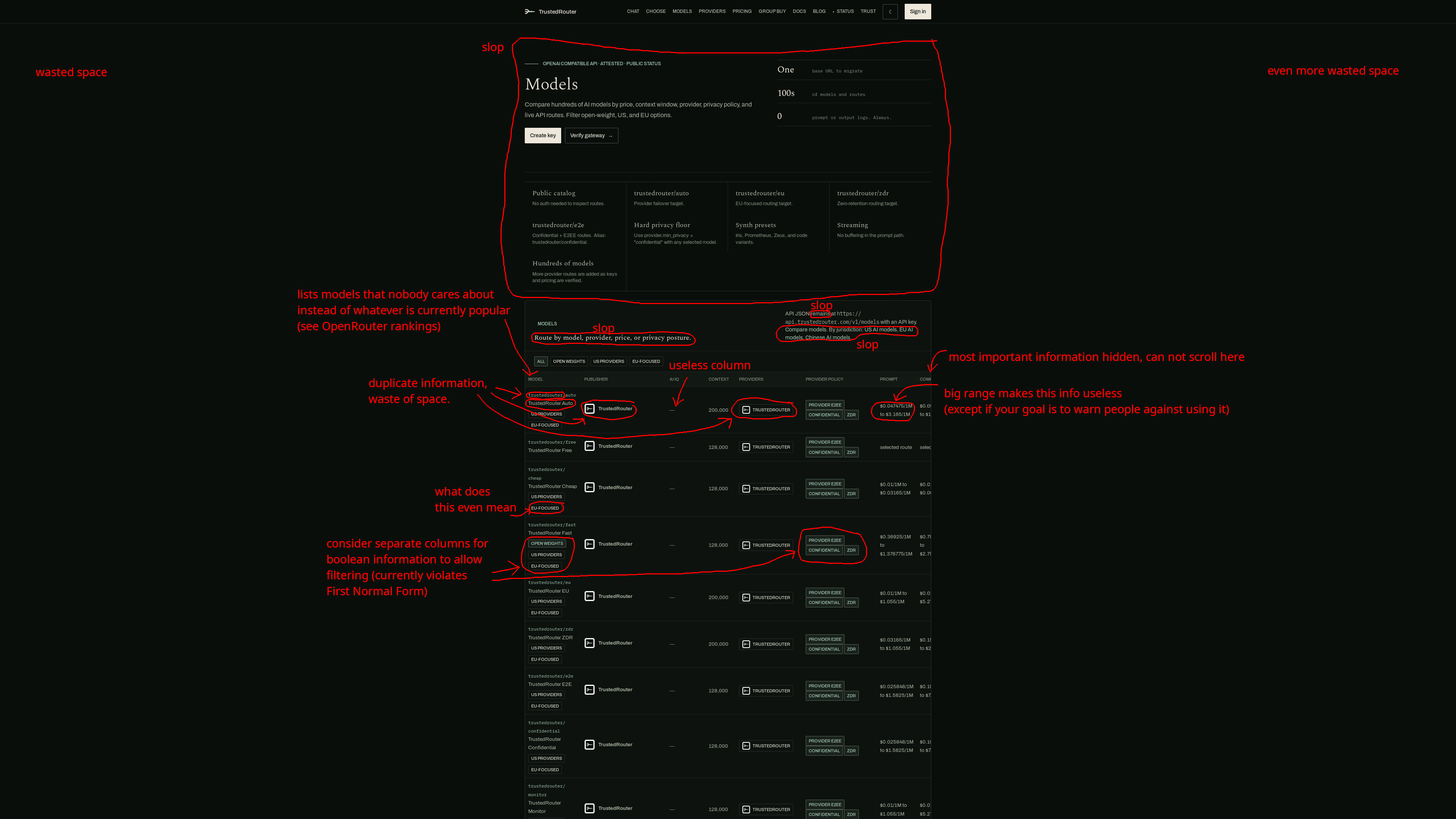
My visit to your website went like this:
1. Visit models page
2. Try to find GLM-5.3-Flash (which is among the ~5 models that 90% of people currently care about)
3. Give up scrolling (which would have taken OVER 50 SCROLLS!!!) and use Ctrl + F
4. Try to find input/output/cached price
5. Scroll all the way up to find out which column is what
6. Notice that output price is cut off
7. Notice that the scroll bar is over 100 scrolls further down the page
8. Use Shift + Wheel to scroll horizontally (most visitors probably won't know this trick)
9. Notice that cached price is missing
10. Conclude that this is probably not a serious offering and bounce
There are probably more issues later on, but this is how far I got.
I would suggest you to:
- Deslopify all pages that a user may visit before conversion
- List important models first (see OpenRouter rankings)
- Move the most important information (model name/input/output/cached price) to the left
- Disaggregate the prices per provider (maybe subtables per model? not sure)
- Measure cache hit rate and compute effective price per provider (see OpenRouter)
(- Optional: Fix the broken link on your HN profile page. Currently, the only way to get from this comment to your website is a search engine.)
ljlolel 8 hours ago
thanks for the feedback, didn't realize people looked there instead of just asking their agents these days. I updated that page
crossroadsguy 11 hours ago
How am I supposed to navigate around there? For example the pricing page is empty or is that how it was supposed to look? On models and providers pages there are lists but no way to filter or get any kind of meaningful info. Or is this a WIP/POC?
ljlolel 3 hours ago
updated the pricing page link to the models page, and added search
we are doing billions of tokens a day and thousands of users
stavros 12 hours ago
Have you guys been having a good experience with OpenRouter? I tried it out recently with Claude, and it cached no tokens, charging me $200 for one conversation of 11 messages.
akie 11 hours ago
I just checked because I was a bit paranoid, but I have a 96.6% cache hit rate for GPT-5.6 Luna and 96.8% for Opus 5.
stavros 11 hours ago
Hm, thanks, it must have been some OpenWebUI bug, thank you.
DefineOutside 11 hours ago
I tried using deepseek v4 flash with OpenRouter. It switches between providers too eagerly which resets the cache. Then, each provider begins to rate limit me for providing so many uncached tokens, so it just keeps on switching providers. I'm paying for every token... why rate limit me? It was unusable compared to just using the official Deepseek provider which has a much better cache rate.
eikenberry 5 hours ago
You really need to select your provider with Openrouter to get the best experience.
https://openrouter.ai/docs/guides/routing/provider-selection
creativeSlumber 11 hours ago
their cache hit rate is 67%. In comparison the provider with the highest hit rate is at 95%.
matheusmoreira 8 hours ago
DeepInfra has excellent terms of service too!
redox99 10 hours ago
I find GLM 5.3 Flash more interesting than 5.3. The fact 5.3 does not have vision is kind of a deal breaker. Also 5.3 Flash seems to be better at making pretty UIs.
kixiQu 11 hours ago
Does this mean it'll be on Bedrock soon? I hear great things about this model but I want AWS data handling practices...
daemonologist 10 hours ago
I doubt it - AWS hasn't added any non-western models since GLM 5 and MiniMax M2.5 in February, afaik. Might be a deal with OpenAI (GPT 5.4 was the first to be available via Bedrock, in April) or might just be that there isn't a lot of demand due to corporate skittishness around models trained in China.
hhh 9 hours ago
many of them (kimi k3, glm-5.3) have license requirements to sell them with model-as-a-service.
_ink_ 8 hours ago
What data handling practices exactly? If it's about privacy there is TensorX.ai, which claim to host in Europe and be GDPR compliant
pal9000i 13 hours ago
how feasible is it build a SOTA specialized model for some use case e.g. deal sourcing by using this as pre-trained model or a LORA or similar pattern on top? Gonna shoot my shot at a billion dollar business
tyre 10 hours ago
Not feasible. We’ve seen again and again that generalized models—somewhat surprisingly—dunk on specialized ones in almost all cases.
The first case of this I remember was Bloomberg thinking that their extensive private data about markets would give a home-trained model better performance in finance tasks. The next version of ChatGPT beat them.
With how often new versions of frontier models are released, you likely won’t finish your work before it’s obsolete. The labs have whole teams dedicated to specific getting training data for specific industries (finance is one), and more powerful generalized models make better decisions even without specialized knowledge.
Your best bet is to get really good at training for something and then sell your company to one of the frontier labs for their post-training efforts.
dsrtslnd23 10 hours ago
yes would also be interested in that - using knowledge distillation and other special knowledge sources to post-train on top of an open model like GLM-5.3. I was wondering that when Elon Musk tweeted "Specialist AI’s (single language, single area of knowledge) are another 100X" (src: https://x.com/elonmusk/status/2089968914596045178) - maybe he knows something regarding specialist model training the general public does not know?
jamesforestwest 5 hours ago
Interesting model. It's nice to see open-weight models catching up with the top proprietary ones. The coding benchmark results are pretty impressive. Overall, it's great to see progress moving forward. Curious to see how it performs in real-world usage.
hkalbasi 13 hours ago
Is it possible to fine tune this model and unlock / extend its cybersecurity capabilities? I'm scared that maybe we are not ready for an open-weight model with high cybersecurity skills.
milkshakes 13 hours ago
brace yourself
whimsicalism 11 hours ago
kimi already exists and yes it is more than possible. it's coming
0xbadcafebee 10 hours ago
You can fine tune a model from a year ago to get extended cyber capabilities. Fine-tunes dramatically increase capability in specific use cases and don't require a lot of investment. Attackers have been doing this for a while now, they aren't waiting for someone else to make them a security model.
I get how you feel, but it's too late to be concerned. The cat's out of the bag. It's like being scared of moving from the bronze age to the iron age... when everybody already knows how to make iron, and the raw materials are everywhere. People are already making iron spears. We need to make iron shields.
We need open-weight models that are good at finding security holes so we can apply them to all of our software by default, and close every possible security bug, before the attackers find them. Every piece of software in the world should be held for release until it's scanned by a high-powered security model.
This is the same debate we had in the 1990's when strong encryption was considered a munition and not allowed to be exported. This just made the world less secure. And it was pointless anyway, because you can't really stop it being developed and shared. Eventually good sense prevailed and now we all have strong encryption. The same thing applies to security bugs.
matheusmoreira 8 hours ago
I sure as hell hope so. I want to point these models at my own computers and harden everything I own.
The insufferable gatekeeping of the US companies is actively contributing to computer insecurity at this point.
barrenko 12 hours ago
A stake through Amodei's heart.
hdfjkfgkkg 10 hours ago
Amodeis wife was tight with JE, all of this Chinese bs is gonna get banned whether blue or red are in power.
ignoramous 10 hours ago
> Amodeis wife was tight with JE
Apparently, Cami Clark was tight with Eric Schmidt. Per unsealed documents, she seems to have pursued Epstein to invest in her "luxury porn" businesses, after a divorce & going bankrupt? Wild: https://www.wsj.com/tech/ai/claude-dario-amodei-wife-anthrop... / https://archive.vn/MJI7q
ylliu 9 hours ago
These open weight models are catching up pretty quickly recent, I guess that's a nice thing for us
onesandofgrain 9 hours ago
Man, imagine if we didn't have China.
anam0012 4 hours ago
Been using it, works wonders. I think generally the models are good enough now that with enough eval harness we can do a lot of automations.
m00dy 13 hours ago
GLM-5.3-Flash is actually cheaper than deepseek and better than deepseek but no one is talking about yet :)
scosman 13 hours ago
It's actually slightly more expensive ($0.50 vs $0.48), but there's a temporary 50% discount.
I've seen dozens of conversations about it in last 24 hours, and every major inference provided added in first 24 hours. I think it's gaining plenty of traction.
swiftcoder 13 hours ago
It's interesting that OpenCode Go is treating it as 2x more expensive than DeepSeek Flash, even factoring in the 50% discount
re-thc 13 hours ago
Go has API pricing + this weird scaling of how much is it worth. Some models get $60 of usage, some $30 and some $15 etc.
chillfox 12 hours ago
OpenCode Go is becoming less of a good deal by the month. I pretty much only use it for mimo 2.5 pro now, and everything else is either ollama or openrouter.
benjiro29 12 hours ago
OpenCode Go is probably using quantized down DS4Flash. They outsourced to 3th party providers to keep the cost down, and being able to provide that $30 value (instead of the initial $60 > $15).
We saw the same issue with GLM 5.2 when they still published publicly who the providers are on their website. Most ran FP8 but one was doing FP4, so you had this issue where one moment you had the better FP8 and another session you had the FP4 provider.
You can check the internet archive, it was in the FAQ part before they hide/removed it. So if you looked up the providers, and the published quants, yea, ...
Given that a lot of complaints are coming from people that felt OpenCode Go Flash feel like a step down compared to old OpenCode Go/DeepSeek API directly, it smells of a quantized down provider is mixed in.
esafak 13 hours ago
It is a slow for me through z.ai; it does not feel 'flash' at all. But then neither did the new DS Flash. I think they were getting hammered.
JoeLee1991 13 hours ago
I've been using it quite a bit too. My main complaint is that it can be really slow sometimes — like, really slow — and the speed feels pretty inconsistent.
scosman 13 hours ago
z.ai is using all Chinese hardware for flash: https://thenewstack.io/glm-5-3-flash-chinese-chips/
There are other providers with much faster inference, like BaseTen at >100t/s: https://openrouter.ai/z-ai/glm-5.3-flash#performance
malshe 13 hours ago
How do I find out where the openrouter model providers' servers are located?
RussianCow 13 hours ago
If you click on the provider name, the panel that pops up shows a "Region" value. Not every provider lists their region, however.
malshe 13 hours ago
I think the region is just the HQ of the provider. So z.ai's region is Singapore but it's quite likely that their servers are actually in China
RussianCow 10 hours ago
I don't think that's right, or if it is, OpenRouter has incorrect data. Several Chinese companies (headquartered in China) have Singapore listed as their region on OR. And some companies, like Alibaba Cloud, have multiple regions listed.
I'm happy to be proven wrong, but this makes me think that the region is where the servers are, not where the HQ is.
malshe 9 hours ago
I couldn't find any article that states z.ai has a data center in Singapore. There are stories of their new 1 GW data center in China though. Also, openrouter lists HQs on their providers page which matches the regions. https://openrouter.ai/providers
RussianCow 6 hours ago
Interesting. I wonder where they're getting their data from then, because they list Z.ai under Singapore, but everything I'm finding says they're based in Beijing. Same with MiniMax.
malshe 5 hours ago
Many Chinese AI companies have their HQs in Singapore because of US sanctions. If I remember it correctly Manus is also based there. But it's a Chinese company through and through as we know from the events that unfolded after Meta's buyout attempt.
gpm 6 hours ago
Does Chinese hardware mean fabbed in China or designed in China and fabbed by TSMC?
_aavaa_ 13 hours ago
It’s cheaper sure, but it’s very slow. It’s not a drop in replacement
natrys 13 hours ago
I think we don't have a good draft model for better speculative decoding yet (e.g. DFlash 2). Once we do, it will be faster.
_aavaa_ 12 hours ago
It very well could be faster, but right now it isn’t.
dw_arthur 12 hours ago
Not in my experience. Tasks that would normally cost $0.08 on DSV4-Flash have cost me $0.30+ on GLM-5.3-Flash. These costs are after Deepseek's recent increase. Also GLM-5.3-Flash is so slow compared to DSV4-Flash. I would be fine with GLM-5.3-Flash if it was cheaper and at the same speed as DSV4.
I use DSV4-Flash on Max through Deepseek's API. I have been using GLM-5.3-Flash on High through Openrouter which I thought had a 50% discount. I must be doing something wrong for the costs to be off this much.
rew0rk 12 hours ago
Looking at HF, it looks like the unquantized version is half the size of glm-5.2 756 GB vs 1.51 TB. I wonder how they were able to optimize it this well
dannyw 11 hours ago
FP8 experts not BF16.
jauntywundrkind 11 hours ago
FP8 vs BF16. But yeah, nice job.
0xbadcafebee 10 hours ago
Stealth Ox-Alpha was GLM-5.3-Flash, and Ox-Alpha was a strong coder (way better than DS4Flash). With both GLM 5.3 and GLM 5.3 Flash, I don't think I'll need any better coding models. The main thing I need now is faster, not better.
btheunissen 7 hours ago
Yes I really don’t a reason to not switch all my team to use GLM 5.3 for planning, and Flash for implementation. This really does seem apocalyptic for Anthropic and OAI if more of the industry switches.
chillfox 13 hours ago
Seeing the price, I am probably just going to keep using GLM-5.2 until 5.3 gets cheaper.
bel8 13 hours ago
isn't GLM 5.3 flash better than GLM 5.2 overall?
0xbadcafebee 10 hours ago
GLM 5.3 Flash is equivalent to 5.2, which is still awesome considering it's 10x-17x cheaper
keel-control 12 hours ago
glm 5.3 flash is the best model I have ever used
ChildOfChaos 13 hours ago
How much usage do you find you get on these kinda models (I know the pricing changes a bit) compared to a $20 sub say for Google AI Pro in anti gravity?
I hate how difficult it is to compare prices when looking at subscriptions.
Would $20 in open router, using models like GLM get me more or less?
nozzlegear 12 hours ago
I think it'd get you less than a $20 sub to any of the big three. I've used it on OpenRouter and found it kind of expensive for the results, but that might change now that it's open weight and other providers can host it/compete with Z.ai. For the work I did with it, I would've rather used DeepSeek V4 Flash just because it's more economical and still gives good results IMO.
Z.ai does have their own subscription, but I haven't used it because their privacy policy was pretty buns last time I checked.
ChildOfChaos 12 hours ago
Yeah I used Ox alpha earlier this week when it was free and deepseek flash when it was free on opencode. Both were great. Z.ai’s subscription doesn’t look very good versus the others.
I burn through my current Google AI pro sub for the week in about 2 and a half days so wanted something extra to add to it, but don’t want to buy any expensive ultra plan. Flash models have got me about 98% of what I need, but quotas are still a bit low.
BeetleB 11 hours ago
> but I haven't used it because their privacy policy was pretty buns last time I checked.
What did you find objectionable? I looked at it when I subscribed almost a year ago and I was fine with it (e.g. they don't train on your API inputs).
matheusmoreira 8 hours ago
Z.ai gives itself a perpetual license to all of your inputs and outputs.
BeetleB 8 hours ago
For API users, it says:
"The Company do not store any of the content the Customer or its End Users provide or generate while using our Services. This includes any texts, or other data you input. This information is processed in real-time to provide the Customer and End Users with the API Service and is not saved on our servers."
0xbadcafebee 10 hours ago
I made a little project to calculate that. It gets the prices for API access and subscriptions, and calculates an average cost per token, for a given rate limit. So the cost is cheaper if you get a higher rate limit (cuz you get more tokens per dollar): https://codeberg.org/mutablecc/calculate-ai-cost
tl;dr API cost (openrouter) is always more expensive than a subscription (for the same given model). you should always use a subscription first and only go to API pricing if you run out of your subscription.
In terms of which subscription is best, different ones provide different models, different amounts of tokens, different rate limits. So it depends on what model you want and how much you need to use it. The frontier ones are always more expensive than open weight ones, but a few subscriptions are starting to include frontier models like GPT-5.6 Luna (which is a great deal but not necessarily the best price-per-performance).
alfiedotwtf 10 hours ago
I’ve been trying out GLM 5.3 Flash the past < 30 hours, and although I’m only running at Q3, it feels different than most 100B to 200B models I’ve run before... More measured, thorough in thinking, and has so far passed all my private tests (and at Q3).
muditjai 11 hours ago
Nice how much does it cost?
rgbrgb 13 hours ago
just tested (zai-org/GLM-5.3-Flash via together.ai) against latest DeepSeek-V4-Flash for a very specific task and thought i'd report here...
- price: DS4 wins... $0.0235 vs $0.0242 for ten tasks
- latency: GLM wins... 108s total against 154s
this is for a personal use-case where i'm detecting ads in a written transcript. sticking with ds4-flash for now since latency is not a critical factor